

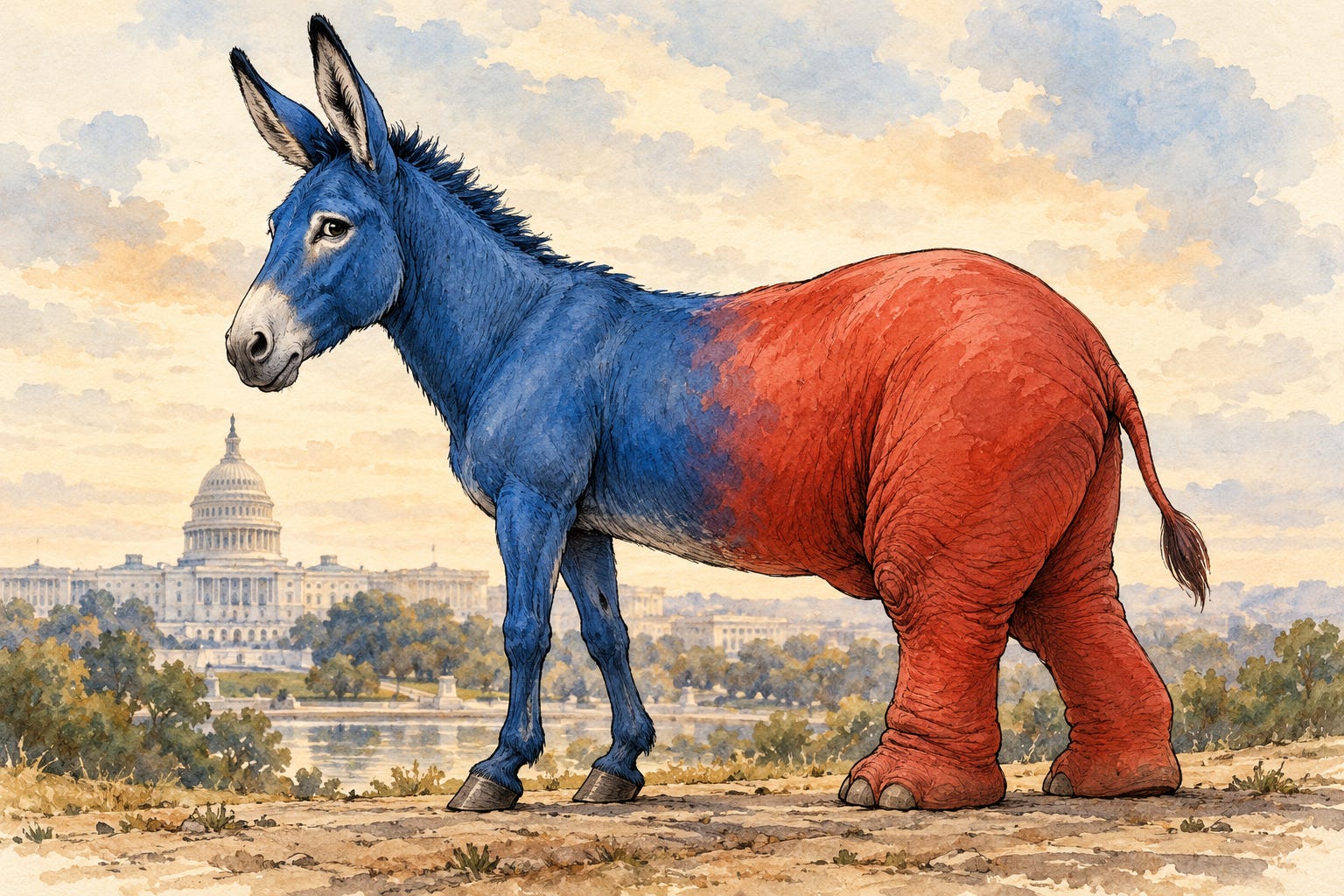
My assessment of fourteen Senate races suggests a wider range of outcomes—and a lower probability of Democratic control—than much of the commentary allows, including the possibility of an expanded Republican majority. Despite Trump’s failures, past polling errors, Republican advantages in red states, and costly Democratic mistakes could turn apparent pickup opportunities into narrower defeats, while Michigan and possibly Minnesota could flip Republican.
Senators serve six-year terms, so the seats regularly scheduled for election in 2026 were last contested in 2020. Comparing expectations and outcomes then with polling and expectations today provides a useful test of claims that Democrats have widened the map. Democrats did well in 2020: Biden won the presidency, and the party flipped Republican-held seats in Arizona, Colorado, and both Georgia races, while losing Alabama—a net gain of three seats that produced a 50–50 Senate following Georgia’s January runoffs.
Today, Republicans again hold 53 seats, but Democrats need four net pickups because the Republican vice president breaks ties, and their path to control runs largely—but not entirely—through states they failed to flip in 2020. Fourteen states are in play in 2026: Maine, North Carolina, Ohio, Texas, Iowa, Kansas, Alaska, Nebraska, South Carolina, Mississippi, Georgia, Michigan, Minnesota, and New Hampshire.
In 2020, polls encouraged Democratic hopes for a large transformative blue wave.
The gap between the cited pre-election polling margins and actual outcomes, from highest to lowest, was 12.4 percentage points in Maine, 9.7 in Alaska, 9.2 in Montana, 7.4 in Kansas, 7.0 in Mississippi, 6.6 in South Carolina, 6.1 in Iowa, 4.6 in North Carolina, and 4.4 in Texas.
Current polls showing close contests—or even Democratic leads—in deep-red states may be overstating Democratic support, as many polls did in 2020. But there are differences between 2020 and 2026.
Trump is not on the ballot to motivate participation by his base, which is highest in the deep-red states that have shown the largest moves toward Democrats. This explains why Trump is urging voters to pretend he is on the ballot. Some rural red states are also in play because of an economy weakened by tariffs and high fuel prices.
The nomination of far-left Democratic Socialist, anti-Israel candidates in three states – Michigan, Maine and Minnesota – has assisted Republican campaigns. Perhaps equally important, the low approval of Democratic Socialists among centrist voters reduces support for a Democrat controlled congress even in states or districts where the Democrat nominee is a centrist.
Democrats are portraying this election as a referendum on Trump. Republicans are portraying this election as a referendum on Democratic Socialism.
The elections determining control of both the Senate and the House are both a choice between competing ideologies and competing candidates.
Lean Democrat:
I lean toward the Democratic candidates in these four states, where experienced nominees capable of appealing beyond the party’s base strengthen their prospects.
North Carolina: Former governor Roy Cooper is an exceptional candidate who has never lost an election. He should win, although his margin may be smaller than the polls suggest in this historically competitive state.
Georgia: Republicans had a shot here, but Mike Collins has given Ossoff substantial ammunition: defending Trump’s tariffs, continuing to claim Trump won the 2020 election, and praising an Ole Miss counterprotest video that included racist taunts against a Black student. These positions and statements make appealing to moderate voters more difficult and help explain why I favor Ossoff.
New Hampshire: The state’s Democratic lean and Chris Pappas’s experience and appeal to both the party’s base and political center favor Democrats. Republican former senator John Sununu is a credible opponent, but a recent Saint Anselm College poll showed Pappas leading 50–43.
Ohio: Ohio has a strong Republican lean, but Sherrod Brown is well known and well liked, and October 15–19 Fox polling showed him leading Republican Jon Husted 52–47. Vivek Ramaswamy’s divisive campaign for governor could also drag down the Republican ticket, particularly after an attack ad featuring Amy Acton’s estranged mother drew condemnation from Republican Governor Mike DeWine. I give Brown the edge, although the state’s partisan lean makes this a difficult pickup.
Toss-Ups
Trump has helped put Republican seats at risk in Texas, Alaska, and Iowa. Minnesota presents a different problem: a traditionally blue state where Democrats’ own failures and divisions have created an opening.
Texas: Trump’s decision to back the scandal-plagued Ken Paxton over experienced incumbent John Cornyn helped put this seat in play. Polls are close, with some giving James Talarico a small advantage, but the pro-Democratic polling errors of 2020 warrant caution. And let’s face it: Talarico is no Lloyd Bentsen—or even Ann Richards.
Alaska: Democrats have a strong candidate in Mary Peltola, who has already won statewide. The Trump Justice Department’s premature effort to block certification if Senator Dan Sullivan narrowly loses looks like panic and risks alienating independent voters. Even Republican Senator Lisa Murkowski said the lawsuit should never have been filed. Trump may again be his own worst enemy.
Iowa: Trump’s tariffs and the war with Iran have helped make this race surprisingly competitive, forcing Republicans to emphasize their independence. I expect Democrats to win the governorship and pick up House seats, but my tentative prediction is that Republican Ashley Hinson will narrowly defeat Josh Turek. She is a capable candidate, and Iowa’s Republican lean and resistance to Democratic control of the Senate may carry her through.
Minnesota: This race deserves more attention. Polls are close, and the welfare-fraud scandal has weakened Democrats in a state they have long dominated. Divisions over Israel add another vulnerability: Ilhan Omar’s appearance with Hasan Piker drew criticism from Amy Klobuchar and Angie Craig, while Peggy Flanagan has avoided a comparable public condemnation. Republican Michele Tafoya has a real opening against Flanagan. I also expect Democrats to lose Craig’s open House seat in MN-02, where Democrat Matt Little faces Republican Eric Pratt.
Polls look encouraging for Democrats in these toss-up races, but substantial overstatements of Democratic support in Texas, Alaska, and Iowa in 2020—and the infamous Selzer Iowa polling fiasco in 2024—are reasons for caution.
Lean Republican
The map has expanded, but tighter margins in deep-red states do not necessarily translate into Republican-to-Democratic flips. Kansas, Nebraska, South Carolina, and Mississippi still face that hurdle; in Michigan, Democrats have made one colossal unforced error.
Maine: I am confident Susan Collins will win despite close polling. In 2020, polls consistently underestimated her, and she won by 8.6 points. Her record of delivering for Maine and crossing party lines remains an asset. Troy Jackson’s documented confrontation with a Democratic colleague also gives Republicans ammunition, although some attacks on his temperament have gone too far.
Kansas: Democrats have an unusually strong candidate in pastor Adam Hamilton. Roger Marshall’s history of suing patients over unpaid medical bills is troubling, but his argument that electing Hamilton could make Chuck Schumer majority leader may resonate in this Republican state. I am rooting for Hamilton, but I am not holding my breath.
Nebraska: Democrats have rallied behind independent Dan Osborn against Republican Pete Ricketts. Osborn’s working-class appeal has made the race competitive, but his recent ad targeting Ricketts’s AIPAC support drew a sharp rebuke from Don Bacon, who called its messaging anti-Jewish and anti-Israel. I still expect Nebraska’s Republican lean to prevail.
South Carolina: I expect Darline Graham, Lindsey Graham’s sister, to defeat Annie Andrews, an articulate pediatrician and credible Democratic candidate. Graham’s admission that she was “not that informed on national security” exposed her inexperience, although distance from her brother’s interventionist outlook may carry less electoral cost in today’s climate. Democrats also remember 2020, when encouraging polls preceded a ten-point defeat.
Mississippi: Democrats periodically become excited about Mississippi’s large Black electorate, but converting that potential into a statewide majority has remained elusive. Scott Colom may narrow Cindy Hyde-Smith’s margin, but I do not see enough evidence that this election will break the pattern.
Michigan: I lean toward Republican Mike Rogers because Democrats remain deeply divided over Abdul El-Sayed. Some Jewish voters, including people connected to the attacked Temple Israel community, have serious reservations about his Israel positions and rhetoric. He has apologized for his remarks about the attack, but the damage persists. His unexpectedly narrow primary victory, after polls showed a commanding lead, is another caution, and Haley Stevens’s endorsement has hardly erased the divisions.
Concluding Thoughts:
The similarities to 2020 are hard to ignore: an expanded Democratic map, encouraging polls in Republican states, and the risk that apparent opportunities will produce narrower defeats rather than flipped seats. The difference is that Republicans have created additional vulnerabilities through unpopular policies and unforced errors in candidate selection, especially in Texas and Georgia. Democrats have made their own costly mistake in Michigan, where a divisive nominee threatens a seat they should be better positioned to hold.
Control of the Senate remains in play. Candidate quality, party divisions, and the possibility of another substantial polling miss warrant more caution than the headline numbers predicting a big change suggest. It is entirely possible the composition of the new Senate will be similar to the current one.
I truly hope this election brings good people to Washington and meaningful restraint on Trump, but there are candidates in both parties whose victories I would find deeply troubling. I suspect many centrists share my view that electing Republicans Ken Paxton in Texas and Roger Marshall in Kansas, or Democrats Troy Jackson in Maine and Abdul El-Sayed in Michigan, would be bad for the country. There are people in both parties whose character, judgment, or conduct makes them unfit for the responsibilities they seek. My hopes for this election depend on who wins, as well as which party controls the Senate.
Author’s note: The Senate is only half the story. My companion article examines 35 marquee House races that could determine control of the chamber, weighing candidate quality, polling, and local conditions. Despite Republican headwinds, my race-by-race assessment suggests either party could win—even a 218–217 split remains possible. The opening races are free to read; the remaining analysis is available to paid subscribers. Follow the subscription offer in that article to receive 50 percent off an annual subscription—$30 for the year.
