

I want artificial intelligence to succeed. I also want data-center developers to bear the costs their projects impose on other people.
Those goals are consistent. Opposition to data centers creates a problem for companies seeking to expand and an opportunity for a political agreement: a clearer path to development in exchange for reducing the costs imposed on consumers and communities.
The memo, Data Center Growth Without Making Other Consumers Pay, examines policies addressing these costs, including approaches proposed in Pennsylvania and adopted in Ireland. Local pollution is one concern: Virginia’s Department of Environmental Quality is monitoring nitrogen dioxide, fine particulate matter, and carbon monoxide near data centers in response to concerns about emissions from backup generators and gas turbines. Higher electricity bills are another: the Ohio Consumers’ Counsel warns that growing data-center demand can raise residential electricity prices and require infrastructure investments whose costs could fall on other customers.
A second problem extends beyond the communities hosting these facilities: electricity generated from fossil fuels to meet growing data-center demand produces carbon dioxide that contributes to global warming. The International Energy Agency examines how both fossil fuels and clean energy will supply this expansion.
A cap-and-trade program covering electricity generation could address this climate problem by limiting total covered emissions while allowing producers to choose the least costly ways to comply. This article asks whether opposition to expansion could encourage data centers to accept enforceable clean-energy obligations—and whether that agreement could also build support for broader emissions limits.
Cap-and-trade programs combine an emissions limit with flexibility over how to meet it. Government establishes a cap on pollution from covered sources and issues a corresponding quantity of allowances. Each regulated company must surrender allowances for its emissions. Companies that can reduce pollution inexpensively can sell surplus allowances; companies facing higher reduction costs can buy them.
Trading lowers the cost of meeting the collective limit. It does not eliminate that limit. A declining cap requires covered emissions to fall over time, provided monitoring and enforcement are effective.
Allowances can be auctioned or distributed without charge. Auctions generate public revenue that can help households or finance public investments. Free allocations can ease opposition from affected industries, although their design matters: valuable allowances are a benefit to their recipients.
This approach has a substantial history. In Lessons Learned from Three Decades of Experience with Cap-and-Trade, Richard Schmalensee of MIT and Robert Stavins of Harvard examine seven major trading programs:
Leaded gasoline: Trading helped refiners meet requirements to reduce lead in gasoline.
Acid rain: The federal sulfur dioxide allowance program covered power plants.
Southern California’s RECLAIM program: Trading addressed nitrogen oxides and sulfur oxides from covered facilities.
Eastern U.S. nitrogen oxides programs: Interstate trading addressed emissions contributing to ozone pollution.
Regional Greenhouse Gas Initiative (RGGI): Participating northeastern and mid-Atlantic states established carbon trading for electricity generation.
California: A broader program covered greenhouse-gas emissions across multiple sectors.
European Union: An international emissions trading system covered power generation and major industrial sources.
These programs differed in scope and design. Their experience provides evidence about both the usefulness of trading and the importance of sound rules.
The International Carbon Action Partnership’s Emissions Trading Worldwide: Status Report 2026 extends this review to more recent developments, including two important Asian programs:
South Korea: Launched in 2015, its national system covers electricity generation and major industries. Its latest phase increases auctioning and introduces a market stability reserve, illustrating how governments adjust trading rules as programs mature.
China: Its national system initially focused on electricity generation and used emissions-intensity benchmarks rather than a fixed limit on total emissions. Under that approach, permitted emissions can increase as production grows. The 2026 report describes plans to move toward an absolute cap by 2027 and expand industrial coverage.
These examples reinforce an important distinction: emissions trading does not necessarily impose a fixed limit on total pollution. For rapidly growing electricity demand, the relevant question is whether the program requires cleaner production per unit of output or constrains total emissions across covered sources.
The United States nevertheless failed to establish a comprehensive federal carbon-trading program.
In June 2009, the House passed the Waxman–Markey climate bill by 219–212. Only eight Republicans supported it, while 168 opposed it. Democrats were divided as well: 44 voted against the bill. The effort subsequently failed in the Senate.
The central political difficulty is straightforward. Even an efficient way to reduce emissions imposes costs on some businesses and consumers. Trading provides flexibility, but it does not remove disputes over energy prices, international competition, or who should bear the adjustment.
Business support has never been uniform in either direction. In 2007, the U.S. Climate Action Partnership, a coalition of businesses and environmental organizations, called for mandatory greenhouse-gas reductions with cap and trade as its central mechanism. Corporate support for a national framework was therefore possible well before the data-center boom.
The question now is whether a growing industry’s need for electricity and development approvals could strengthen that support.
Probably the best way forward would begin with direct obligations on large new data centers, including major expansions of existing facilities. Developers should finance additional clean electricity sufficient to match their incremental demand, supported by storage and other resources needed for dependable delivery. They should also pay the grid and reliability costs attributable to their projects, provide guarantees that other customers will not pay for unused infrastructure if a project closes or fails, and meet standards protecting neighboring communities.
The principle should be that new demand pays for the additional resources it requires. Existing customers should pay their share of improvements that demonstrably benefit them; developers should not inherit responsibility for unrelated grid deficiencies or historical emissions. Requiring additional supply and attributable cost payments would reduce the risk of shifting costs to households, although it could not guarantee that electricity prices would remain unchanged.
Developers could comply through long-term contracts supporting new clean generation, direct investment, or payments into a dedicated fund financing new clean electricity that regulators can verify. Long-term contracts would provide revenue commitments that generation developers could use to obtain financing. Qualifying resources could include new or expanded wind, solar, nuclear, geothermal, and other verified low-emissions generation. Buying certificates that merely reassign claims on existing electricity would not qualify.
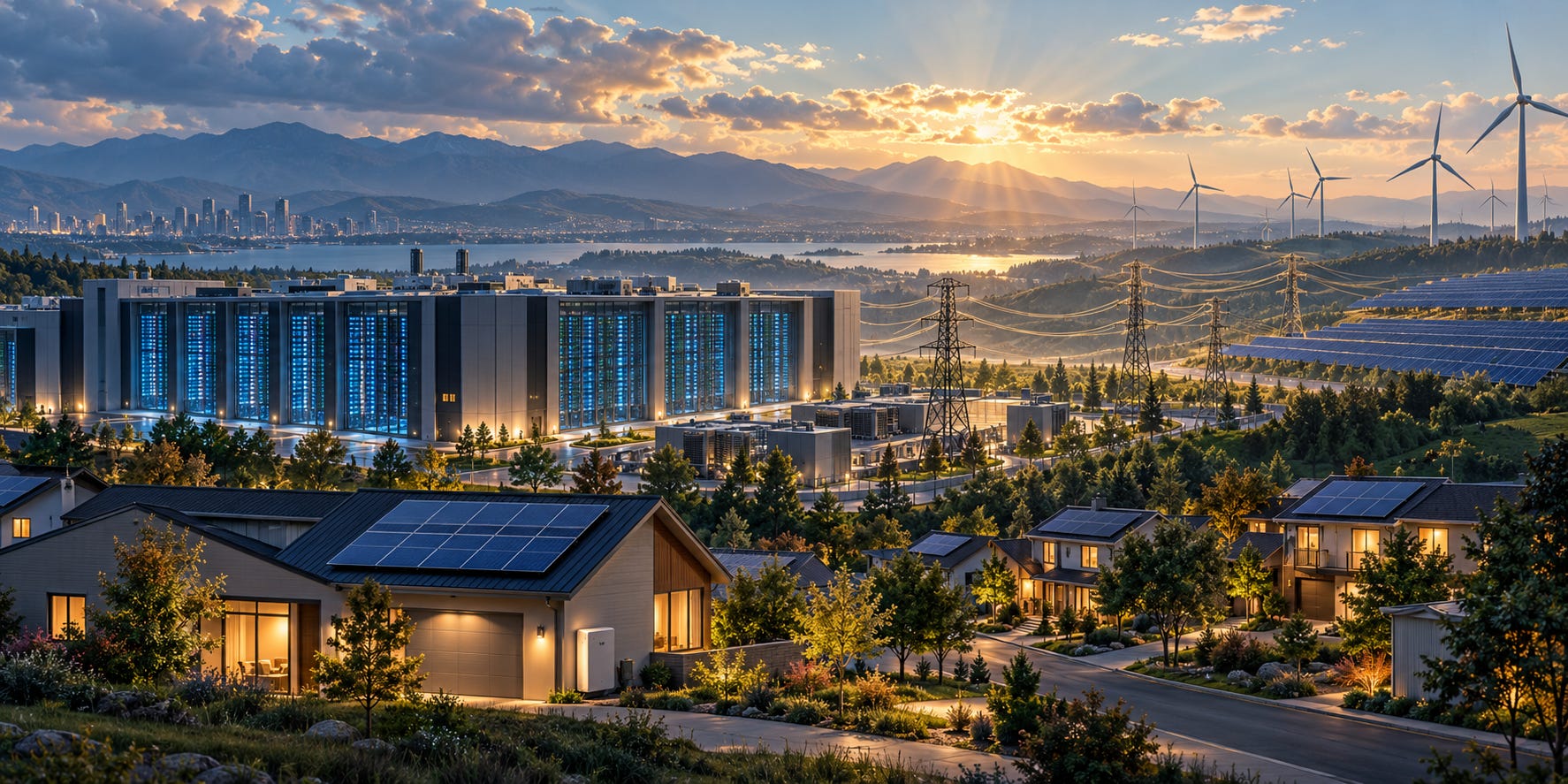
The program should also allow data-center developers to help households purchase solar panels and home batteries as part of meeting their clean-electricity and reliability obligations. Households could receive help with installation costs and payments for verified additional solar generation or for using their batteries to reduce demand on the grid when electricity is scarce. Fair connection rules and transparent grid charges would allow household-owned equipment to compete with utility-owned projects, giving families a direct benefit through lower bills and backup power.
A trading mechanism could give developers flexibility. A data center that finances more qualifying clean electricity than its obligation requires could sell the surplus certificates to another data center subject to the requirement. For example, a developer financing 120 megawatt-hours of qualifying electricity against an obligation of 100 megawatt-hours could sell certificates for the remaining 20 megawatt-hours. Regulators would verify additional supply, prevent double counting, and establish rules specifying where and when the electricity must be available. Separate reliability requirements would ensure that annual energy matching does not substitute for dependable service.
This would be a tradable clean-supply obligation rather than conventional carbon cap and trade. It would borrow the flexibility of trading while placing the principal financing obligation on the industry seeking permission to expand. It would help accommodate new demand with cleaner supply but would not impose an absolute cap on emissions across the electricity system.
A broader carbon cap modeled after RGGI could complement this arrangement. RGGI requires covered fossil-fuel power plants to hold allowances for their carbon dioxide emissions. A similar program could establish a declining power-sector cap that would not automatically rise with data-center demand. It would affect electricity serving existing customers as well as new ones, so its costs and household protections would need separate consideration. We should not wait for a national carbon agreement before requiring data centers to pay their way.
Neither approach eliminates the need for community protections. A carbon cap does not directly regulate excessive noise, water consumption, inappropriate siting, or every pollutant released by backup generators. Additional clean generation could reduce some associated air pollution, but benefits would depend on which plants reduce output and where replacement generation is built. Enforceable operating and siting standards would remain essential.
These obligations could become part of a political agreement because developers have something to gain from accepting them.
For a company facing delays, litigation, or a prohibition on construction, enforceable environmental commitments may be less costly than being unable to expand. A predictable framework could make investment easier to plan. Communities and climate advocates, in turn, could gain measurable obligations in place of voluntary promises.
The financial stakes also extend to households whose retirement savings depend partly on the industry’s success. As the Wall Street Journal reports, pension funds have substantial exposure to AI-related investments, giving retirement savers a stake in resolving the conflict over expansion.
The immediate bargain is straightforward: data-center developers finance the additional clean electricity and infrastructure their growth requires in exchange for a clearer path to approval at suitable locations. Technology companies need permission to expand. That need could give them a reason to finance additional clean electricity and support broader limits on carbon emissions.