

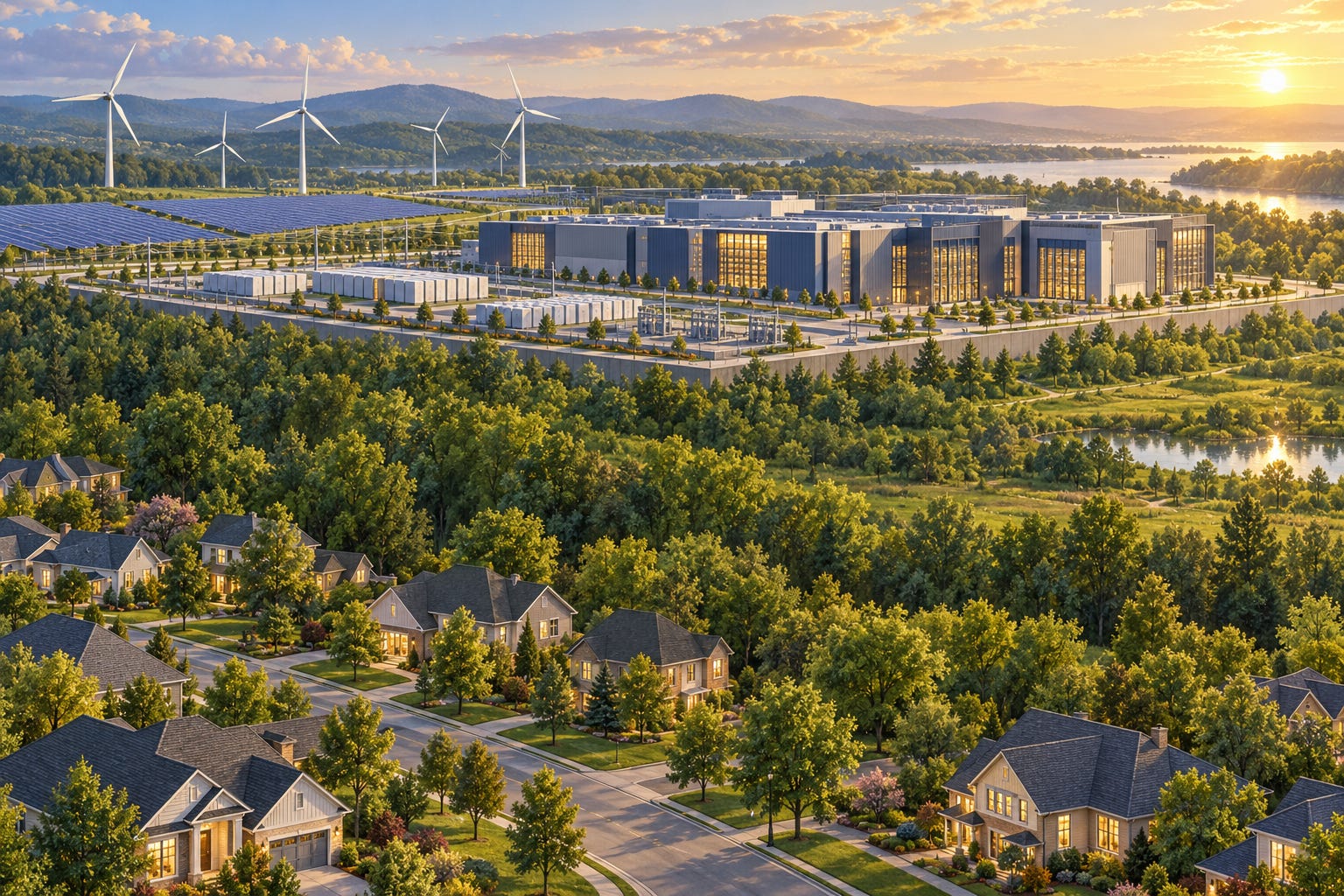
The AI-driven surge in data center construction is straining local electric grids and threatening climate targets.
First, nearby communities can experience noise, generator exhaust, water demands, and pressure on electricity infrastructure. In Loudoun County, Virginia, data centers’ diesel backup generators emit nitrogen oxides and particulate matter, prompting state regulators to monitor air quality near concentrations of data centers. Existing electricity customers have already faced higher prices. According to the Ohio Consumers’ Counsel, many Ohio consumers saw electricity supply prices increase by 10 to 35 percent in June 2025, at least partially stemming from the growth of data centers.
Second, the climate problem becomes more difficult when rapidly growing electricity demand coincides with federal policies obstructing clean-energy development. The International Energy Agency’s 2026 assessment projects that emissions associated with data centers will roughly double to about 350 million metric tons by 2035.
Meanwhile, the Trump administration is seeking to rescind approval for the nearly completed Revolution Wind project. Expanding electricity demand while obstructing low-emissions supply increases reliance on fossil fuels relative to a path that allows clean generation to expand, worsening the climate consequences of the data-center boom.
A carbon cap-and-trade program could limit greenhouse gas emissions while allowing reductions wherever they can be achieved most cheaply. But a carbon cap would not guarantee clean air for a neighboring household, control noise, or prevent other customers from paying a data center’s infrastructure costs.
Credible policies must address both greenhouse gas emissions and local costs, requiring developers to finance additional clean electricity and needed infrastructure while protecting surrounding communities. These obligations could also reduce political resistance and provide a clearer path for continued expansion.
Ireland has adopted a connection policy linking new data-center demand to additional renewable electricity and supporting capacity. Pennsylvania has proposed legislation combining additional clean-electricity requirements with protections for existing customers. Together, they offer useful foundations for a practical policy that allows the industry to expand while requiring it to bear the costs it creates.
The political consequences of failing to address these costs are becoming difficult for the industry to ignore. Data Center Watch reports that local opposition disrupted at least 45 projects representing $68 billion in proposed investment during the second quarter of 2026. The backlash now extends to statewide restrictions. In July, New York imposed a one-year pause on certain state environmental permits for new data centers capable of consuming at least 50 megawatts, while officials develop standards addressing their environmental and energy impacts. In August, Texas paused new data-center approvals pending a review of electricity-grid connections. Maine’s legislature passed a moratorium covering new facilities requiring more than 20 megawatts until October 2027, but Governor Janet Mills vetoed it, objecting to its treatment of a project already underway.
Local governments have gone further by adopting outright prohibitions. centers throughout its zoning districts, while Smithfield, Rhode Island, also adopted a townwide prohibition. Temporary permitting pauses and permanent local bans are different policies, but both demonstrate the risks companies face when communities believe development will impose unacceptable costs. Enforceable requirements to finance additional clean electricity, protect other customers, and safeguard neighbors could offer a more constructive path to expansion.
The disputes concern tangible burdens. In Edgerton, Kansas, the city sued residents seeking a vote on a data-center ban; after that case was dismissed, residents sued to get the measure onto the ballot. In Sterling, Virginia, a data center ran diesel generators for nearly 24 hours during a power failure, prompting complaints about exhaust and noise near homes. Financing additional clean generation would address part of the problem, but neighbors also need enforceable safeguards governing generator emissions, noise, water use, and siting.
There is public support for requiring the industry to address these costs. A University of Chicago–AP-NORC poll finds bipartisan majorities supporting requirements that data centers use clean energy and pay for grid upgrades. Linking permission to expand with responsibility for additional supply and infrastructure is therefore a reasonable response to identifiable burdens. The obligations should reflect the costs a project creates, with shared infrastructure costs allocated among those who benefit.
For technology companies, an enforceable path to approval could be preferable to bans, prolonged litigation, and uncertain development schedules. For those of us who want artificial intelligence to succeed, allowing expansion subject to meaningful protections is preferable to an outright prohibition where those protections can adequately address the harms. This creates an opportunity for a political bargain: companies finance additional clean electricity, pay their attributable infrastructure costs, and meet neighborhood safeguards in exchange for a clearer path to development.
Ireland offers a practical example of tying data center development to enforceable energy obligations. Ireland’s Commission for Regulation of Utilities adopted a new electricity connection policy for data centers in December 2025. It requires at least 80 percent of annual electricity demand to be matched with additional renewable projects generating in Ireland. Projects previously or currently contracted through specified government support programs cannot count toward that obligation. For larger connections, the policy also requires onsite or nearby generation and/or storage capacity sufficient, after accounting for dependable availability, to match the facility’s requested maximum electricity import demand.
This approach connects new demand with the responsibility for expanding supply. But it has limitations. Developers receive a six-year transition for the renewable projects to begin generating, and annual renewable matching does not ensure clean electricity is available during every hour. The separate generation-and-storage requirement addresses capacity adequacy but does not require all that capacity to be clean.
Pennsylvania’s proposed Data Center Act offers a complementary approach, with particular attention to the costs imposed on existing customers. The version examined here—House Bill 1834, Printer’s Number 3061—combines financial protections with an obligation to procure additional clean firm electricity. Its principal provisions include:
Applies to data centers with peak electricity demand of at least 25 megawatts.
Requires data centers to pay for the grid improvements and reliability costs they create, with financial guarantees to protect other customers.
Requires payments to help low-income households with energy bills and fund clean-energy projects.
Requires additional clean electricity from Pennsylvania to cover 10 percent of electricity use in 2027, 14.5 percent in 2030, and 32 percent in 2035.
Requires qualifying electricity to meet firm-service standards and come from new plants or improvements that increase existing plants’ output.
Allows data centers to buy qualifying electricity, buy certificates representing additional clean electricity, or make compliance payments.
Allows regulators to temporarily lower the targets when qualifying supply is insufficient.
Ireland’s principal advantage is its substantially larger obligation for additional renewable electricity. Pennsylvania’s proposal gives more explicit attention to infrastructure costs, financial guarantees, and assistance for low-income customers, while allowing a broader range of qualifying clean resources.
An ideal program would combine elements of the Pennsylvania and Irish approaches, making arrangements for additional clean electricity a condition of service for large new data centers. Pennsylvania’s targets are too modest: requiring additional clean electricity for less than one-third of consumption in 2035 leaves most demand outside that obligation. Qualifying investments should demonstrably expand clean electricity supply through new or expanded wind, solar, nuclear, geothermal, or other verified low-emissions generation. Buying certificates that merely reassign claims on existing generation would not qualify.
The goal should be to match all additional consumption with additional clean electricity, with an explicit timetable and enforceable milestones for any transition. Developers must also demonstrate dependable service when power is needed and pay the infrastructure and reliability costs attributable to their projects. Separate operating and siting standards should protect neighboring communities from excessive noise, harmful generator emissions, and unsustainable water demands.
A broader cap-and-trade program could complement these requirements by limiting carbon emissions across power generation and placing a price on emissions from supplying additional demand. Congress attempted this approach in 2009, when the House passed the Waxman–Markey bill, but the Senate never passed it.
Cap and trade offers an economically efficient way to limit emissions because sources facing high reduction costs can purchase allowances from sources able to cut emissions more cheaply, while total covered emissions remain constrained by the cap. Applied broadly to power generation, it would give electricity suppliers an incentive to account for the carbon consequences of growing data-center demand.
The need to accommodate the data-center boom could create a new constituency for cap-and-trade programs if the industry concludes credible emissions limits would help secure public acceptance of expansion.
Federal policy should support these efforts by allowing clean generation and the transmission needed to deliver it to expand alongside new demand. Obstructing clean supply while encouraging rapid data-center construction works against affordability, reliability, and emissions reduction. As I argue in “Trump and Biden on Wind and LNG,” we need stable energy policy not one that shifts with each administration.
The central requirement should be straightforward: permission to consume large amounts of additional electricity must come with enforceable responsibility for financing the clean power and infrastructure that make that growth sustainable, together with safeguards for the communities hosting it.
Sources
Ohio Consumers’ Counsel — Quick Facts: Data Centers in Ohio
Monitoring Analytics — Analysis of the 2025/2026 RPM Base Residual Auction, Part G, June 3, 2025
International Energy Agency — Key Questions on Energy and AI, Executive Summary, 2026
Pennsylvania House Bill 1834 — Printer’s Number 3061
Data Center Watch — Q2 2026 Report
Reuters — New York Becomes First State to Impose Data Center Moratorium, July 14, 2026
Reuters — Where Authorities Are Restricting Data Centres Amid the AI Boom, August 18, 2026
University of Chicago–AP-NORC — Americans’ Views on the Impact of AI and Data Centers, 2026
The Texas Tribune — San Marcos Becomes the First Texas City to Ban Data Centers, June 30, 2026
The Wall Street Journal — The Kansas Town That Sued Its Own Residents to Build a Data Center
WUSA9 — Virginia Couldn’t Stop Sterling Data Center’s 24-Hour Diesel Generator Use, July 20, 2026
U.S. Environmental Protection Agency — Why Do Emissions Trading Programs Work?
CT Mirror — Trump Administration Seeks to Rescind Approval for Revolution Wind, October 13, 2026
