

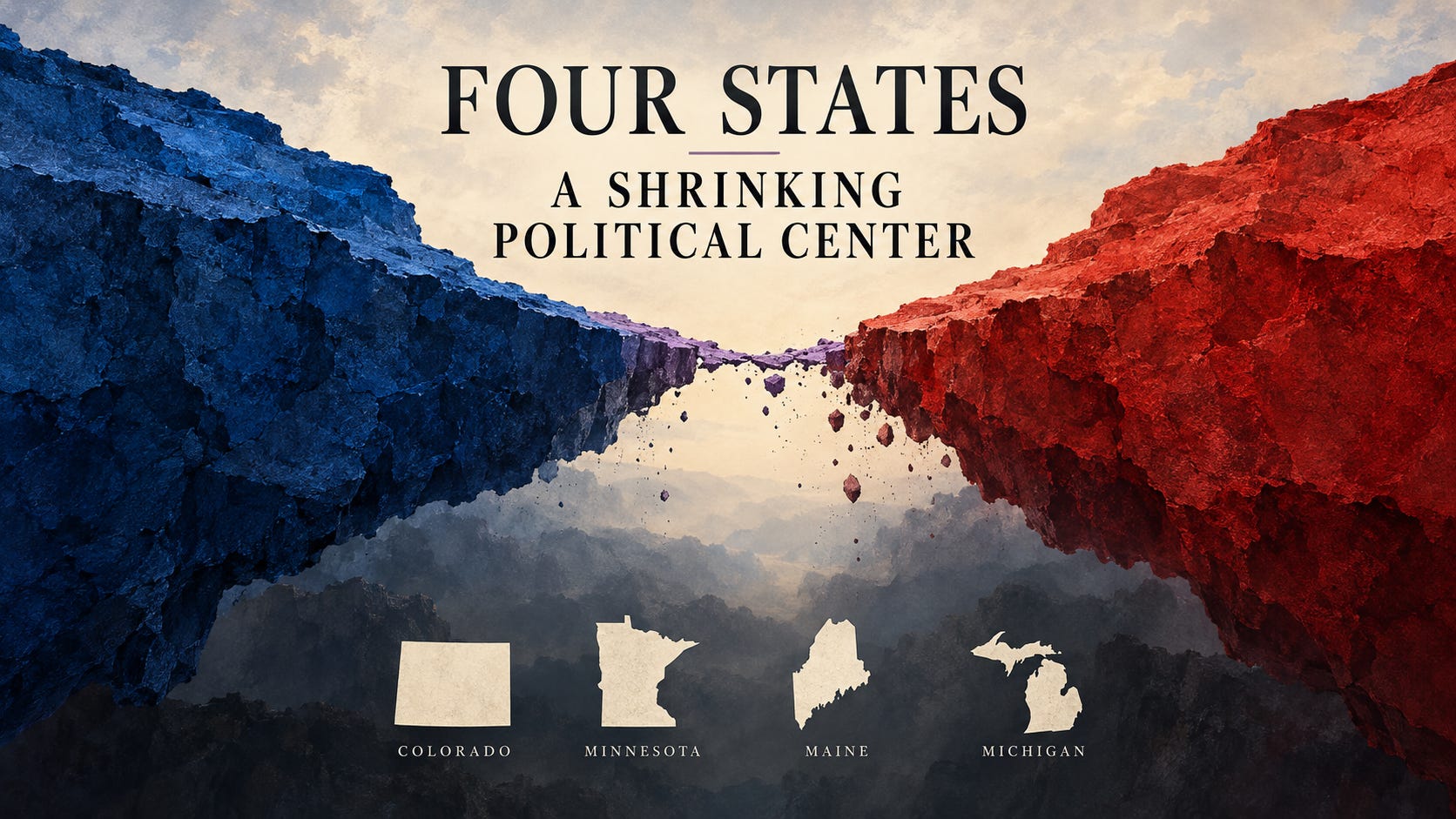
I am in the process of separating my economics and finance writing from my political commentary. Economics and finance will remain on Substack; my political writing is moving to Medium. Follow me on Medium for more political analysis.
The migration begins with four essays:
· A Resident’s Guide to Colorado Politics
· Will Republicans Flip Minnesota?
· Maine Could Tip Congress and Its Center of Gravity
· An Open Letter to Michigan Voters: Why This Centrist Supports Mike Rogers
I’ll start with Colorado, where I live. The state is not a major battleground in 2026. CO-08 is the one true toss-up, although Jessica Killin and Eileen Laubacher could flip Republican seats if a blue wave develops.
The larger story is how the state is changing. Democrats have moved sharply left, the political center is vanishing, and two safely Democratic congressional districts have no scheduled debates. Independent Senate candidate Bob Chew offers some hope for voters seeking a credible alternative.
I expect this movement toward the fringes to accelerate. By 2028, I fear Colorado and New York could have Senate contests in which neither major party nominates someone acceptable to centrists. Chew’s candidacy offers an opportunity to begin building a political center now. Voters who want meaningful choices may need to organize independent movements—or their own parties—soon after the 2026 election.
Minnesota offers an early look at this problem. The Democrats have nominated far-left candidates for the Senate and the Second Congressional District. The Republican nominees are burdened by Trump’s high unfavorable ratings in this Democratic-leaning state, but an upset is possible.
Maine could help determine control of Congress and, more importantly, the degree of polarization within it. Paul LePage, the Republican nominee for ME-02, was MAGA before Trump. If elected, he would replace retiring Congressman Jared Golden, an effective centrist. Troy Jackson, a candidate favored by the far left of the Democratic Party, would, if elected, replace Senator Susan Collins, who has tempered her party’s more extreme proposals.
Michigan’s Senate race has prompted me to cross party lines to support Mike Rogers over Abdul El-Sayed. Read the open letter to Michigan voters to understand why?
All four essays on Medium are free to read through the links in this article. Enjoy!
Follow me on Medium for more political analysis.
In too many House races, the choice is between a socialist and a Republican who, even if personally outside MAGA, can be expected to vote with Trump. That leaves voters in the center who want practical reforms that work with no appealing choice. In 2026, this problem is concentrated in House races—even in some swing districts. But, the Senate races in Michigan and Maine are already dominated by fringe figures. I expect more Senate races in 2028 to be dominated by the fringe including the possibility of far-left Democratic Senate nominees in New York and Colorado. The shrinking center is becoming a problem well beyond safe House seats.
I also hope to see a resurgence of non-MAGA Republicans. Like Susan Collins, Mike Rodgers, and others. I was one before I became an independent. They're more electable in general elections. My only suggestion and condition for them is they have to say the words Jihad, Sharia Law, and Radical Islam when campaigning. They can practice my saying it in the mirror.