

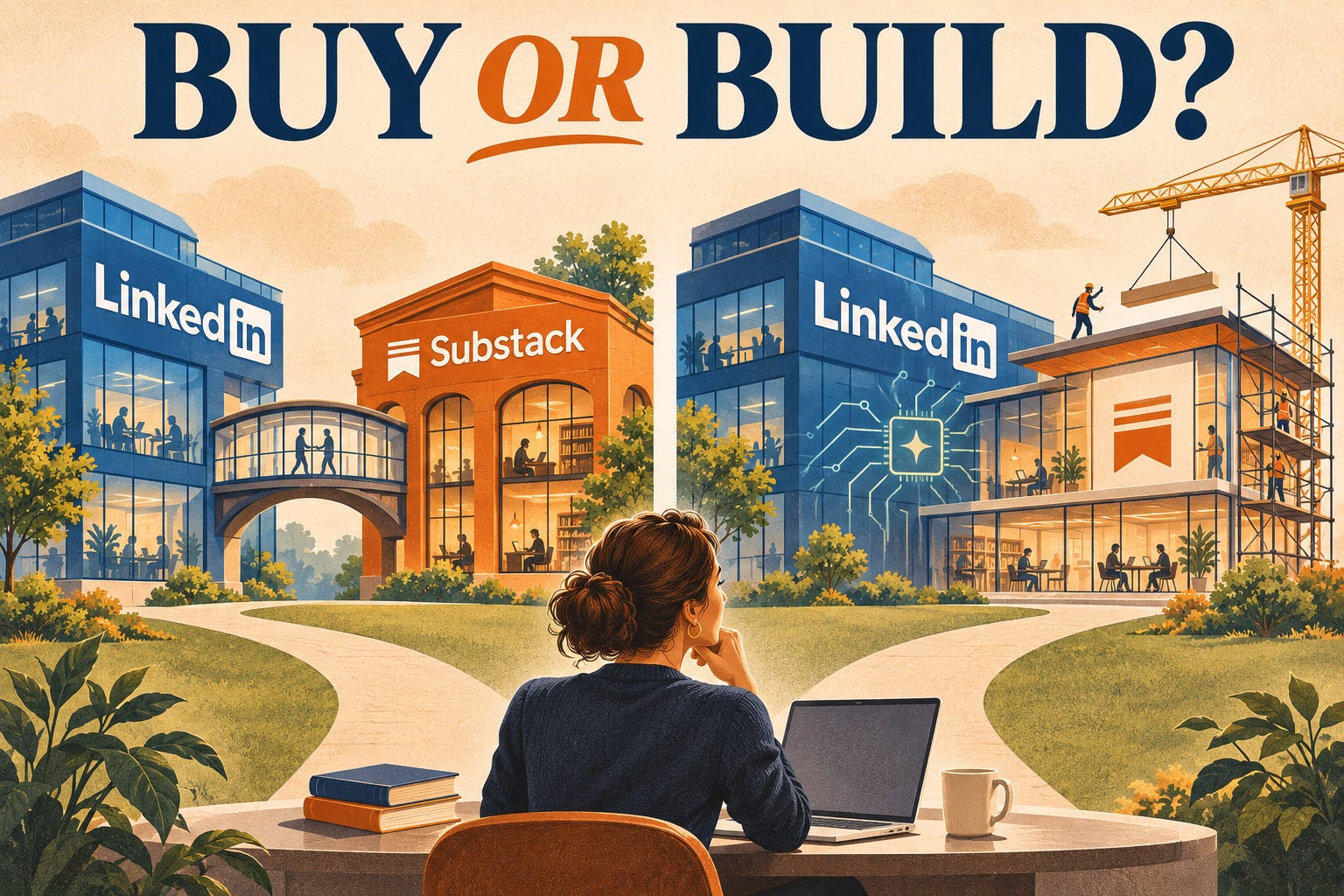
I have more followers and connections on LinkedIn than on Substack, where I publish economic analysis and struggle to generate meaningful subscription income. In fact, more people are reading my Substack material on LinkedIn than on Substack.
Could combining LinkedIn’s professional network with Substack’s paid publishing system improve writers’ earnings while generating additional platform revenue? Would the acquisition of Substack by LinkedIn be the most cost-effective way to expand opportunities for the two firms and for writers or should LinkedIn and Substack remain separate while pursuing partnerships through contracts? Alternatively, should LinkedIn construct its own paid publishing platform to compete with other platforms like Substack and Medium?
These are questions about revenue synergies: whether connecting complementary businesses creates sales opportunities that neither could exploit as effectively alone. LinkedIn supplies professional audiences and targeted advertising; Substack supplies paid publishing and subscriber relationships. Parker and Van Alstyne’s research on two-sided network effects provides a framework for understanding how connecting content providers and readers can create additional value. Whether obtaining these benefits requires acquisition is a separate question.
There are at least four ways revenue could be expanded through combinations of Substack and LinkedIn.
First, integrated subscriptions could help LinkedIn newsletter authors launch paid editions and existing Substack writers convert interested LinkedIn readers into customers. A subscription button, connected payment system, and integrated reading experience could reduce the steps between discovery and purchase. Substack currently receives 10% of subscription payments, with processing fees charged separately.
Second, the combined company could extend LinkedIn’s existing premium subscriptions with an additional tier for bloggers and newsletter authors. LinkedIn already offers Premium Business for professional networking and Premium All-in-One, which combines sales, marketing, and hiring tools. A publishing tier could adapt these services to writers’ needs, adding advanced readership analytics, targeted promotion, paid-subscription management, and AI assistance with editing, translation, and production. Writers could upgrade an existing subscription or purchase a publishing add-on, generating recurring revenue for LinkedIn beyond subscription commissions. For writers, the potential benefit would be faster audience growth and more paid subscribers, provided those gains justified the additional expense.
Third, advertising could be the largest opportunity. Writers earning subscription income would have stronger reasons to purchase targeted promotion. LinkedIn already sells newsletter and article advertising; easier subscription purchases and better measurement could make those advertisements more productive.
Fourth, an integrated publishing platform could keep readers on LinkedIn longer. Readers could access complete articles and paid editions without leaving the platform, potentially making them more likely to finish articles, join discussions, and return for subsequent posts. Reading an article would no longer require leaving LinkedIn and interrupting their other activities on the platform.
The company could therefore receive subscription commissions, premium-service fees, and advertising payments from the same publishing business. These revenues would be sustainable only if authors also earned enough to justify their expenses. Useful publications could additionally encourage repeat visits and attract sponsors.
What might Substack cost?
Substack’s July 2025 financing valued it at approximately $1.1 billion. That historical benchmark is not an acquisition price. For discussion, $1.5 billion–$2 billion is a plausible negotiating scenario; $3 billion or more is conceivable if competing bidders anticipate substantial growth and revenue synergies. These figures are illustrative assumptions, not reported offers or estimates supported by current financial statements.
For perspective, Microsoft’s LinkedIn offer carried a 49.5% premium over its preceding closing share price.
Competitive bidding also raises the possibility of the winner’s curse: the most optimistic bidder wins but pays more than the business ultimately justifies. Richard Roll’s The Hubris Hypothesis of Corporate Takeovers explains how managerial overconfidence and valuation errors can produce excessive acquisition bids.
The economics literature on this, as with most issues, is split. Grossman and Hart’s research on ownership explains why companies sometimes buy a business rather than contract with it. Holmström and Roberts explain why complex cooperation can sometimes work without common ownership.
There is one substantial problem with this potential combination. A substantial portion of Substack’s audience involves politics, personal feuds and unrelated material that is largely inconsistent with LinkedIn’s core business network. LinkedIn could acquire Substack and spin off its nonbusiness activities but a lot of brands span multiple issues and still may not fit. Perhaps part of Substack could be spun off to a separate firm?
LinkedIn already has publishing tools, an audience, and advertising capabilities. Adding a paid publishing application to the existing framework could cost substantially less than acquisition, especially if bidding inflated the purchase price. This might be a good time to build a new AI-software engine that takes advantage of new technology and the displacement in the industry.
I would expect opposition to acquisition, particularly from “progressive” critics of technology concentration. I frequently put the word “progressive” in quotes because I increasingly fail to see how “progressive” policies would improve the world. In this case, I believe there is a substantial opportunity for this tech combination to increase revenue and earnings for freelance bloggers, and I fail to see what is “progressive” about stopping that outcome.
Might Meta or X instead combine with Medium? Medium founder Evan Williams also cofounded Twitter and reportedly sought an unsuccessful $500 million sale to Twitter before Musk’s ownership. Either combination could create a larger reservoir of outrage and low-quality commentary—while proving quite profitable. Also, I have no problem with the generation of metaphorical trash if it provides a struggling freelance writer some additional income.
Author’s Note: The author and publisher of this blog is a retired economist who spent most of his career at the U.S. Treasury. He is open to consulting opportunities.