

Executive Summary: The Mismatch of Caregiver Finance
Current legislative efforts to close the “caregiver gap”—specifically the Improving Retirement Security for Family Caregivers Act and the Catching Up Family Caregivers Act—rely on a fundamental misunderstanding of household economics. By focusing on increasing contributions to managed retirement accounts, Congress provides a windfall for investment firms while ignoring the practical needs of families.
The Savings Paradox: It is fundamentally illogical to “motivate” additional retirement savings at the exact moment a caregiver’s income has dropped or disappeared. Policy should instead focus on increasing general IRA contribution limits during high-earning years and creating parity between IRA contributions and 401(k) contributions.
The “SECURE” Playbook: Like the SECURE Acts 1.0 and 2.0, these new bills prioritize keeping assets locked in high-fee, firm-sponsored plans rather than facilitating debt reduction or flexible liquidity.
The Liquidity Penalty: Caregivers are often forced to raid retirement accounts for survival, yet the tax code continues to punish them with penalties. A superior approach would replace tax penalties with a cap on allowable pre-retirement distributions to protect core balances while allowing emergency access.
The Mortgage Priority: For many households, mortgage elimination provides far greater retirement security and tax-free cash flow than a marginally larger, volatile, and fully taxable retirement account.
Special Offer for New Readers
If you find this analysis valuable, consider becoming a subscriber. I am currently offering a 90-Day Free Trial for full access to the Economic and Political Insights premium research, including deep-dive memos on retirement adequacy, mortgage-payoff strategies, and tax-efficiency audits.
Claim Your 90-Day Free Trial Here
Current Legislative Proposals
Two primary bipartisan bills, reintroduced in April 2026 by Senators Mark Warner (D-VA) and Susan Collins (R-ME) along with Representatives Brittany Pettersen (D-CO) and Maria Elvira Salazar (R-FL), represent the latest attempt to fix the retirement gap through asset accumulation:
1. Improving Retirement Security for Family Caregivers Act (H.R. 8274): This bill targets the “earned income requirement.” Currently, IRA contributions are capped at the lesser of the annual limit ($7,500 in 2026) or the individual’s earned income. This bill allows a “qualified family caregiver”—defined as someone providing at least 500 hours of unpaid care with fewer than 500 hours of paid employment—to contribute up to the full $7,500 Roth IRA limit even with zero earned income.
2. Catching Up Family Caregivers Act (H.R. 8273): This bill addresses the “catch-up” tiers. While SECURE 2.0 created a “peak” catch-up limit (currently $11,250 for those aged 60–63), this bill would grant caregivers returning to the workforce up to five additional years of eligibility for these maximum catch-up levels, regardless of whether they meet the standard age requirements.
Comment One: Existing Landscape. The current tax framework for caregivers is defined more by its limitations than by its actual support, creating a significant policy gap for middle-class families. To understand the proposed legislation, one must consider it against these existing features:
The Work Mandate: Benefits like the Child and Dependent Care Credit are strictly tethered to employment; they only offset expenses incurred to enable the taxpayer to work. For a caregiver who leaves their job to provide care personally, the available relief is zero.
The $500 Ceiling: The Credit for Other Dependents—the primary vehicle for those caring for elderly parents—is a mere $500 and is strictly limited by the care recipient’s income, which must be below $4,700 for the 2026 tax year.
The Credit for Caring Act, which proposes up to a $5,000 non-refundable tax credit for eligible caregivers, has effectively languished in committee since its reintroduction. To qualify, a caregiver must have an earned income of at least $7,500 for the year, a requirement that offers no relief to those whose caregiving duties have forced them entirely out of the workforce.
Comment Two: Investment Priorities and the IRA Disparity. The newest legislative proposals for caregivers, much like the SECURE Acts 1.0 and 2.0, appear designed to prioritize the growth of assets under professional management rather than the immediate financial health of the workers. This approach favors the investment industry while leaving several critical structural issues unaddressed:
The IRA-401(k) Disparity: The proposals do not adequately address the gap in allowable contributions between people reliant on IRAs and people with access to 401(k) plans.
Fee Extraction in Managed Plans: SECURE Act provisions that mandate automatic enrollment and delay Required Minimum Distributions (RMDs) do not also mandate automatic rollovers to low-fee accounts often leading to substantial loss of retirement income.
Riskier Investment Options: Recent Congressional proposals and executive orders from the Trump Administration will allow 401(k) investors greater access to risky probably unsuitable investment options.
Congress tends to favor these investment-linked frameworks because they are easier to label as “bipartisan retirement wins” without requiring direct government outlays. However, the result is a system that treats retirement security as a byproduct of asset management fees, prioritizing the stability of investment firms over the practical, liquid needs of families facing a caregiving crisis.
Readers interested in learning more about how Congress tends to prioritize the needs of Wall Street firm over the needs of household should read the essay Evaluating the Secure Act 2.0.
Comment Three: Provisions for additional contributions will have limited effect.
The proposal to allow caregivers to contribute to a Roth IRA without earned income appears to overlook existing spousal IRA provisions and the actual financial constraints of long-term caregivers.
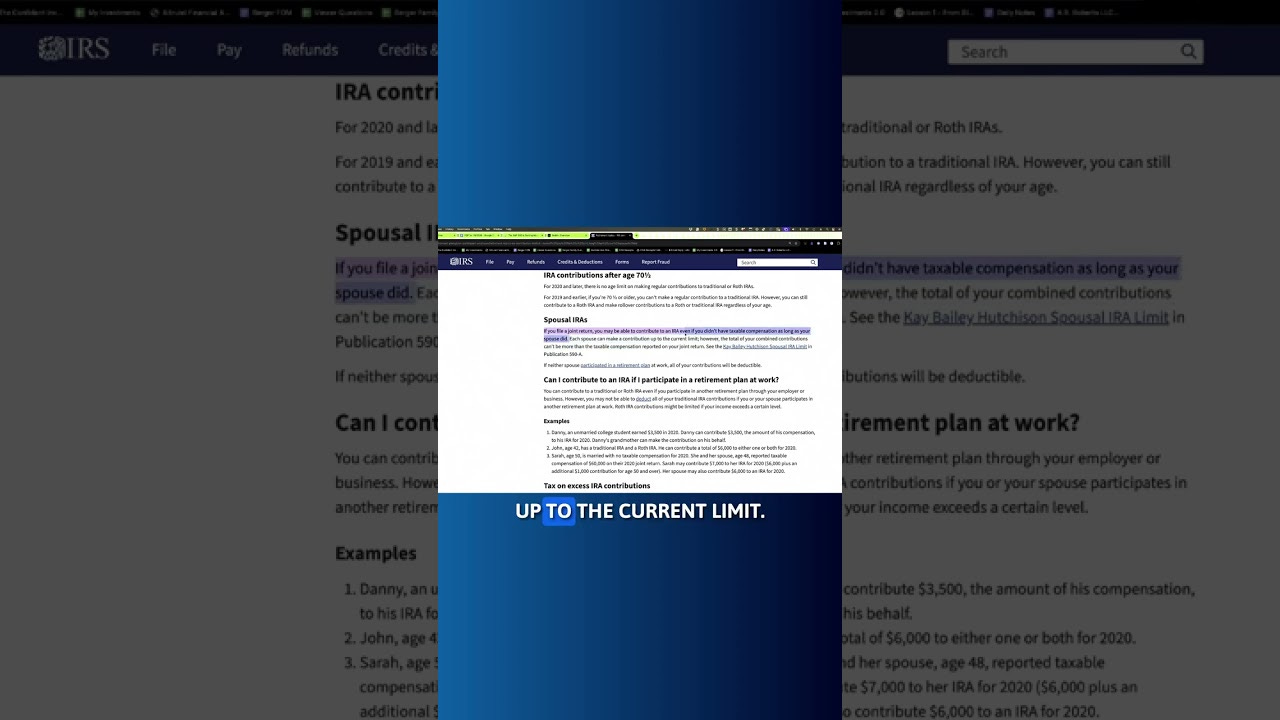
Existing Spousal Benefits: Under current law, a non-working spouse can already contribute to either a Traditional or Roth IRA based on the working spouse’s earnings. The spousal IRA effectively removes the individual earned income requirement for married couples filing jointly, making the new proposal redundant for most married caregivers.
The “Single Caregiver” Gap: While the proposal would technically expand Roth eligibility to single caregivers without income, these individuals—often surviving on limited savings or public assistance—are the least likely to have the discretionary funds required to contribute.
A more effective way to help caregivers prepare for retirement is to address the systemic disparity in contribution limits. Currently, 401(k) limits are significantly higher than IRA limits ($24,500 vs. $7,500 in 2026). Increasing general IRA limits would allow caregivers to save more aggressively when they are actually in the workforce, creating a larger “war chest” before they have to step away for family needs.
Ultimately, motivating additional savings at the exact moment a caregiver’s income has dropped or disappeared is a fundamental policy mismatch. Instead of niche provisions that look good on paper but offer little practical benefit, the government should focus on a general lifting of IRA contribution limits and the removal of the liquidity traps—taxes and penalties—that prevent families from using their own life savings to manage a caregiving crisis.
What is a spousal IRA? This video provides a concise overview of how spousal IRAs work under current law, illustrating why adding separate caregiver provisions may be redundant for many married couples.

Can You Fund a Roth IRA After You Retire?
Comment Four: Improve retirement outcomes by replacing tax penalties on disbursements with limits on overall disbursements
We currently live in a system that “motivates” contributions with generous tax incentives, imposes substantial penalties on withdrawals prior to age 59 ½, and has absolutely no limit on the amount that can be withdrawn prior to retirement.
Caregivers facing financial emergencies are often forced to raid their retirement accounts, only to be hit with taxes and premature distribution penalties.
We should eliminate the existing tax penalties on premature distributions. In their place, a simple “maintenance rule” could suffice—for example, requiring that at least 30% of total contributions remain in the account until age 59½, while allowing penalty-free access to the rest.
This approach is a fairer and more effective way to balance the need for people to save for retirement with the need for funds during emergencies including periods of high expenses when a person must leave the workforce to care for a family member.
Comment Five: The Mortgage-Catch-Up Tradeoff. The bipartisan focus on expanding “catch-up” contributions for caregivers ignores a critical alternative for retirement security: the elimination of mortgage debt. For many households, the most significant driver of financial stability in retirement is not the size of their managed portfolio, but the elimination of fixed cash obligations.
The Tax-Liquidity Paradox: Carrying a mortgage into retirement creates a fixed, non-negotiable cash requirement. When this payment must be sourced from traditional, fully-taxed retirement accounts, it triggers a cascade of negative tax effects—increasing the share of Social Security benefits that are taxed and potentially pushing the retiree into a higher bracket. In contrast, paying off a mortgage prior to retirement reduces the required withdrawal rate, effectively lowering the household’s tax burden and exposure to market volatility.
The Disparity in After-Tax Resources: A retiree reliant on traditional assets may find that nearly half of their after-tax income is consumed by a mortgage payment. While Roth assets can mitigate this early-retirement cash flow squeeze, most households enter retirement with limited Roth balances. For these families, funds used for “catch-up” contributions in their final working years might be more effectively used to retire the mortgage, creating immediate “tax-free” cash flow upon retirement.
Insulation from Tax Creep: Because Social Security taxation thresholds are not indexed to inflation, taxes on retirement income rise faster than inflation. A household with a mortgage and a traditional retirement account sees its purchasing power erode by 15–18% over the first decade, compared to only 6–8% for a Roth-heavy or debt-free household.
The current legislative push assumes that more “savings” is always the solution. However, workers are often better served by achieving debt-free homeownership before they exit the workforce. If Congress wants to support caregivers and retirees, it should recognize that mortgage elimination provides a more tangible margin of safety than a marginally larger, high-fee retirement account and should create more appropriate tax incentives. More on this issue can be found here.
Concluding Remark: The current legislative push for caregivers is a classic example of “Doing Something” while solving nothing. By doubling down on the SECURE Act framework, Congress is merely inviting families to lock more of their dwindling liquidity into high-fee managed accounts. True reform would prioritize household flexibility—lifting IRA contribution limits during high-earning years, removing the IRS “penalty trap” for emergency access, and recognizing that for most families, a paid-off mortgage is the most reliable retirement plan money can buy.