

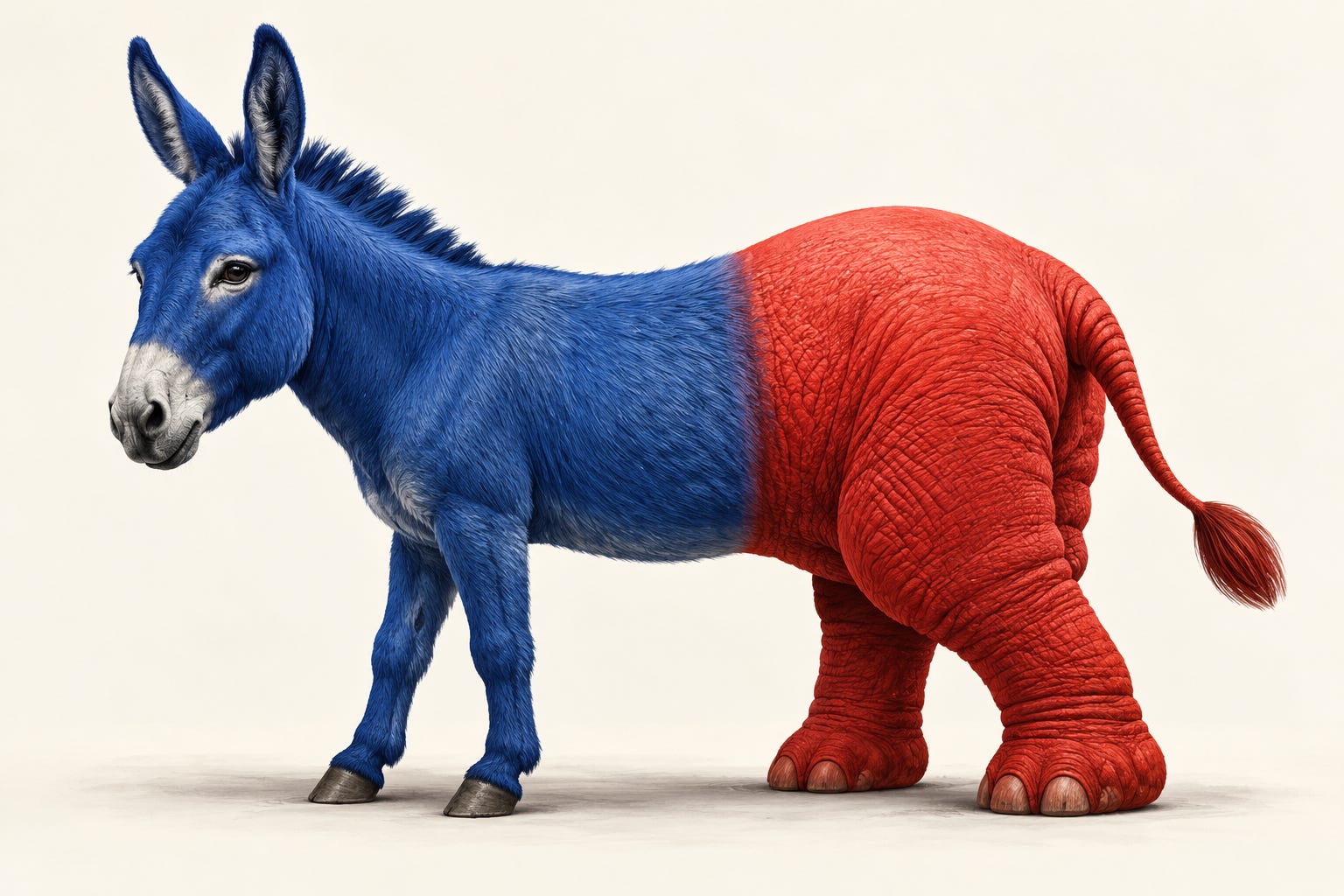
The Donkiphant: AI generated image for David Bernstein 2026
This race-by-race forecast examines 35 House battlegrounds and projects 18 holds, 6 Democratic pickups, and 6 Republican pickups, with 5 races unresolved. The projected flips cancel out, so control in this forecast depends on both the unresolved races and the accuracy of the predicted holds. Candidate quality, incumbency, local economic pressures, and ideological fit with the district help explain why an unfavorable environment for Republicans may not produce a Democratic wave.
The comment section of this post will be updated frequently between now and the election.
The ingredients for a blue wave are present: low approval of Trump, a generic ballot favoring Democrats, higher inflation, and a poorly managed, unpopular war, on top of the usual midterm headwinds for the party in power. But this is not 2008. The country is highly polarized, and gerrymandered districts limit the number of competitive seats. Democrats are also unpopular, and many of the party’s most prominent figures are far to the left, as are some nominees in swing districts. Assessing whether these national conditions will produce a Democratic majority requires a race-by-race analysis.
Q: What are the marquee House races of 2026—and what does an assessment of these races tell us about likely control of the next Congress?
These 35 races will help determine which party controls the House. The list includes Democratic defenses, Republican seats Democrats hope to flip, and several contests that would signal a larger blue wave. They are not equally competitive.
The predictions below are my judgments, rather than a summary of other forecasters’ ratings. Where I lack a clear view, I say so. “Toss-up” means I see a closely balanced contest; “don’t know” means I do not have enough confidence to choose a winner.
The 35 Marquee House Races:
Alaska, at-large: Incumbent Nick Begich (R) faces Bill Hill (independent). My prediction: Begich holds. The family name helps, and I doubt the independent label overcomes voters’ concerns about which party Hill would support in Congress.
Arizona, AZ-01: Amish Shah (D) faces Jay Feely (R) for an open Republican seat. A major suburban pickup opportunity testing both candidates’ crossover appeal. My prediction: Don’t know.
Arizona, AZ-06: Incumbent Juan Ciscomani (R) faces JoAnna Mendoza (D). My prediction: Republican hold. Ciscomani has survived close contests, and incumbency gives him an advantage in another competitive race.
California, CA-22: Incumbent David Valadao (R) faces Randy Villegas (D). The new boundaries help Democrats, but Valadao has repeatedly attracted crossover support. My prediction: Republican hold.
Colorado, CO-03: Incumbent Jeff Hurd (R) faces Dwayne Romero (D). This remains a more difficult Democratic target than Colorado’s principal battleground. My prediction: Republican hold; Hurd wins.
Colorado, CO-05: Incumbent Jeff Crank (R) faces Jessica Killin (D). Colorado Springs is gradually becoming more Democratic, but the process is slow. My prediction: Don’t know whether that movement is sufficient for a flip this year.
Colorado, CO-08: Incumbent Gabe Evans (R) faces Manny Rutinel (D). My prediction: Republican hold. Rutinel’s activist profile strikes me as a poor fit for a district with a significant rural component.
Florida, FL-14: Incumbent Kathy Castor (D) faces Mike Beltran (R). My prediction: Republican pickup. The enormous Republican shift in the boundaries, a weak Democratic Senate ticket and Florida’s broader partisan direction outweigh Castor’s incumbency.
Florida, FL-22: Pia Dandiya (D) faces Casey Askar (R) in a substantially redrawn seat without an incumbent. My prediction: Askar wins. The same combination of Republican-friendly boundaries and weak Democratic statewide prospects drives this call.
Florida, FL-25: Jared Moskowitz (D), displaced from FL-23 by redistricting, faces Scott Singer (R) in a district with an R+3 lean. My prediction: Singer wins, a Republican gain despite Moskowitz’s personal strengths.
I am rethinking FL-25. Will be watching this race closely. Most of my analysis will be free and the annual subscription for paid material only costs $30 with the coupon attached to the annual membership. Hit subscribe for payment options.
