

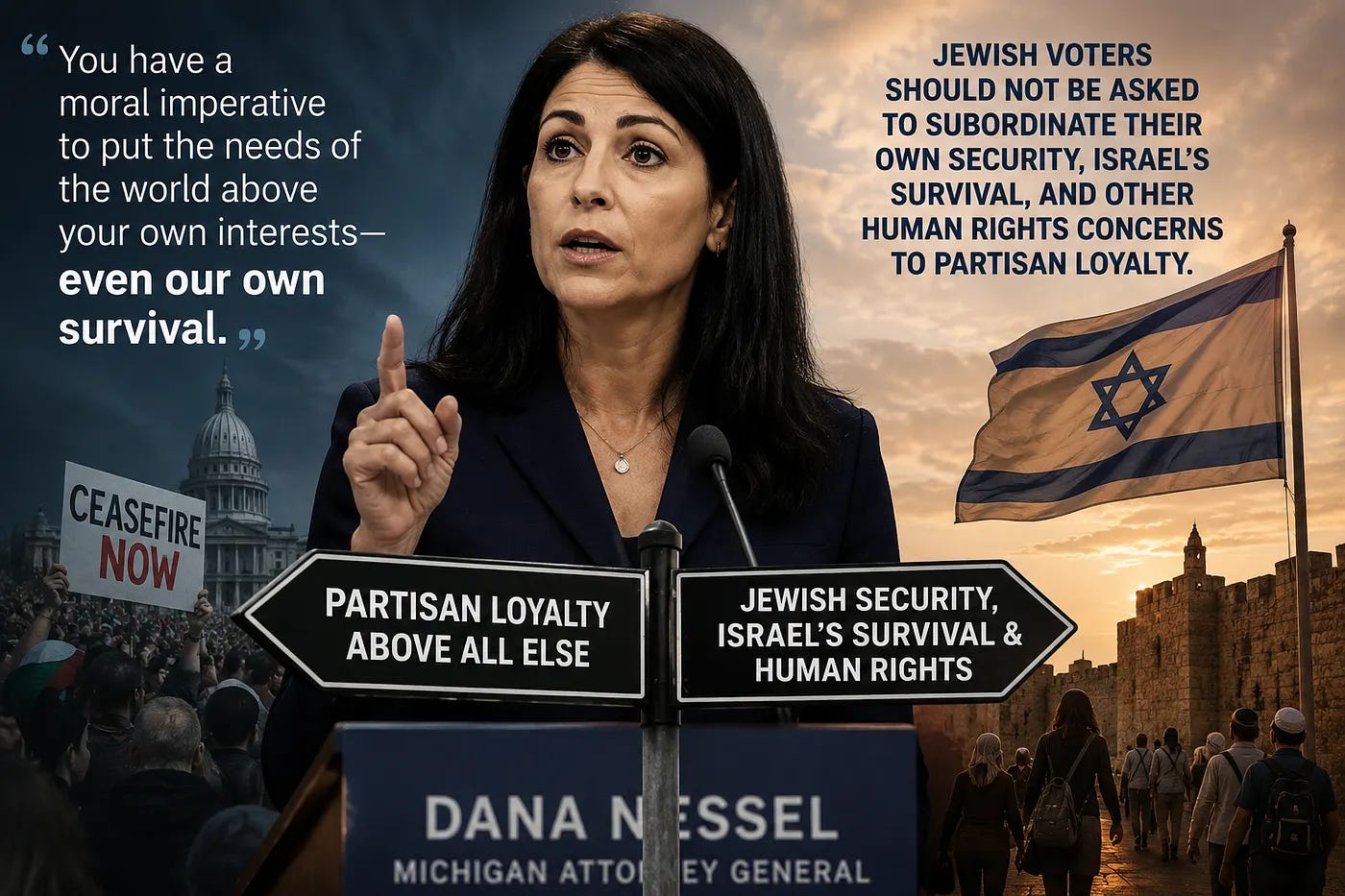
On August 30, 2026, Michigan Attorney General Dana Nessel told Jewish Democrats that they faced a “stark choice.” She acknowledged serious concerns about Israel and Jewish security but argued that Jews have a “moral imperative” to place the needs of the world above their own interests and, if necessary, “even our own survival.”
I have spent most of my life supporting the Democratic Party—the party I associated with Hubert Humphrey, John F. Kennedy, Jimmy Carter and Bill Clinton. But strident partisan appeals increasingly have the opposite of their intended effect on me. Both parties too often ask voters to put party over country or party over principle. In this case, Nessel is effectively asking Jewish voters to put party over their own security and over what I regard as an important human-rights cause.
Although Nessel was speaking in the immediate context of Michigan’s Senate race, the dilemma she describes is much broader. Similar tensions are appearing in other 2026 Senate and House contests, where Jewish voters are being asked to reconcile traditional partisan loyalties with concerns about Israel, antisemitism and Jewish security.
Her appeal is especially unpersuasive because it bundles together several very different claims: that the story of Queen Esther supports collective Jewish self-sacrifice; that voting Democratic is tantamount to protecting the planet; that Jews should subordinate concerns about their own safety even as threats against them have become more tangible; and that defending Israel is somehow a narrower interest than defending humanity. I disagree with all four propositions.
The story of Esther is straightforward. Haman seeks the destruction of the Jews of Persia. Esther can remain relatively safe in the palace or risk her own life by approaching the king. She chooses the latter: “If I perish, I perish.” She risks herself to save her people.
Nessel uses Esther to support a very different proposition. She says Jews may need to sacrifice “the comfort, safety and security and even the very future of our own people” for the opportunity to save humanity. Esther does not sacrifice the future of the Jewish people. Preventing their destruction is precisely why she takes the risk.
There is another awkward aspect to the analogy. Nessel declined to attend the Michigan Democratic convention because she feared being harassed, chased, yelled at or booed—all legitimate concerns. But Haley Stevens, who attended an earlier convention and confronted a hostile crowd, provides the closer analogy to Esther in the biblical story. Stevens took the stage despite loud boos and heckling; Esther, likewise, personally accepted risk on behalf of her people.
Voting Democratic, despite Nessel’s protestations, is not synonymous with saving the planet. Democratic environmental policy is neither efficient nor sustainable.
Democrats have relied too heavily on subsidies and spending rather than economically efficient policies that price environmental externalities. The priorities can also seem badly distorted. The federal government subsidized purchases of electric vehicles, including Teslas, while enhanced health-insurance premium tax credits were allowed to expire and families now face sharply higher health-care costs.
I do not particularly like Republican environmental policy either. As I argued in Trump and Biden on Wind and LNG, Trump was wrong to obstruct economically viable wind power, just as Biden was wrong to impede LNG.
There are reasonable arguments about how best to address climate change. But “vote Democratic or sacrifice the planet” is not one of them.
Nessel’s appeal is especially difficult to accept because Jewish security in America is not an abstract concern. In March 2026, an attacker drove a truck into the preschool entrance at Temple Israel in West Bloomfield, Michigan, before exchanging gunfire with security. In May 2025, two Israeli Embassy staff members were murdered outside the Capital Jewish Museum in Washington. The following month, a man threw Molotov cocktails at participants in a Boulder, Colorado, gathering calling attention to Israeli hostages in Gaza.
These are only some of the recent incidents that make Jewish concerns about safety concrete rather than theoretical. Nessel herself also brought charges arising from pro-Palestinian demonstrations at the University of Michigan and later dismissed them after months of proceedings, while saying the court had failed to rule on probable cause and that the cases had developed a “circus-like atmosphere.”
We live amid an almost compulsive use of public forums to denounce Israel, including settings with little or no connection to the Middle East. Rights of expression are being applied in an unusually one-sided manner. Nessel never asked Palestinian activists to subordinate their cause to some asserted greater good. We would be rightly uncomfortable applying Nessel’s reasoning to other minorities, such as Black Americans during the civil rights era.
There is a deeper disagreement underlying Nessel’s argument. I regard the protection of Israel—and the protection of vulnerable minorities elsewhere in the Middle East and beyond—as one of the paramount human-rights issues of our time.
Israel is a nation of refugees and immigrants. It absorbed Holocaust survivors who had nowhere secure to return to and successive waves of Jews from Iraq, Yemen, Morocco, Algeria, Tunisia, Libya, Egypt, Iran, Turkey and Syria, as well as Jews escaping the Soviet Union and Ethiopian Jews fleeing persecution and extraordinary hardship. The circumstances differed from country to country, but the larger historical point is unmistakable: Israel became a place to which Jews could go when remaining where they were had become dangerous, untenable or impossible. Israeli government statistics document immigration on a massive scale from North Africa, the Middle East, the former Soviet Union and Ethiopia.
I discuss one particularly striking example in this essay on Jewish migration from Ethiopia. Thousands of Ethiopian Jews undertook dangerous journeys because Israel offered a refuge that, for many, was not realistically available elsewhere. But Ethiopia is only one chapter in a much larger story. Israel’s existence means that Jews facing persecution no longer have to depend entirely on whether some other country is willing to admit them.
Nor should that principle stop with Jews. My principal criticism of current policy is that too little is being done to help Iranians seeking freedom from repression and to protect other threatened populations: Bahá’ís, Christians, Jews, Sunnis, women and political dissidents in Iran; Druze, Christians, Alawites, Kurds and other vulnerable communities in Syria; Yazidis in Iraq and Syria; Hazaras in Afghanistan; and other religious and ethnic minorities whose safety cannot be taken for granted.
Protecting societies in which persecuted people can live safely is part of the human-rights project. Israel’s continued existence as a refuge for Jews belongs within that project, not outside it.
Nessel frames the choice as one between Jewish self-interest and the needs of humanity. She is asking me and other Jews to put party over an important human right—the continued security of Jews and the existence of a refuge available to them when other countries will not provide one—and to treat one party’s environmental agenda as synonymous with protecting the planet. Partisan appeals don’t resonate with me, and this one would never have been made by the Democratic Party that I grew up in and supported my entire life.
Haley Stevens got very close a core impediment to peace with Israel. Sanders and other on the left are actually encouraging Palestinians and Hamas and Hezbollah to be more belligerent and is probably one reason they walked away from the Oslo process. They are attempting to drive a wedge between Israel and the United States which will make Israel more self reliant and compromise less. They seem oblivious to the impact of their demands on Israeli security and they don't stand up for Jews who have every right to support Israel and state their position on American campuses. They are encouraging anti-semitism in America. Sanders thinks this is only about El Sayed. it could affect four other Senate races add 20 House races.
the best way to illustrate Nessel's conundrum is to provide example after example. Should Jewish groups support the right of a visa holder who repeatedly posts support of Hamas and a desire to "annihilate" Jews? J Street and those who did support Mahdawhi are now silent. Hope they are having second thoughts. The Constitutional right to free speech does not guarantee access to visas. Congress has given authority over access to visas to the department of state and think they made the right call here. https://jewishinsider.com/2026/09/mohsen-mahdawi-liberal-leaders-silent-antisemitic-social-media-posts/