

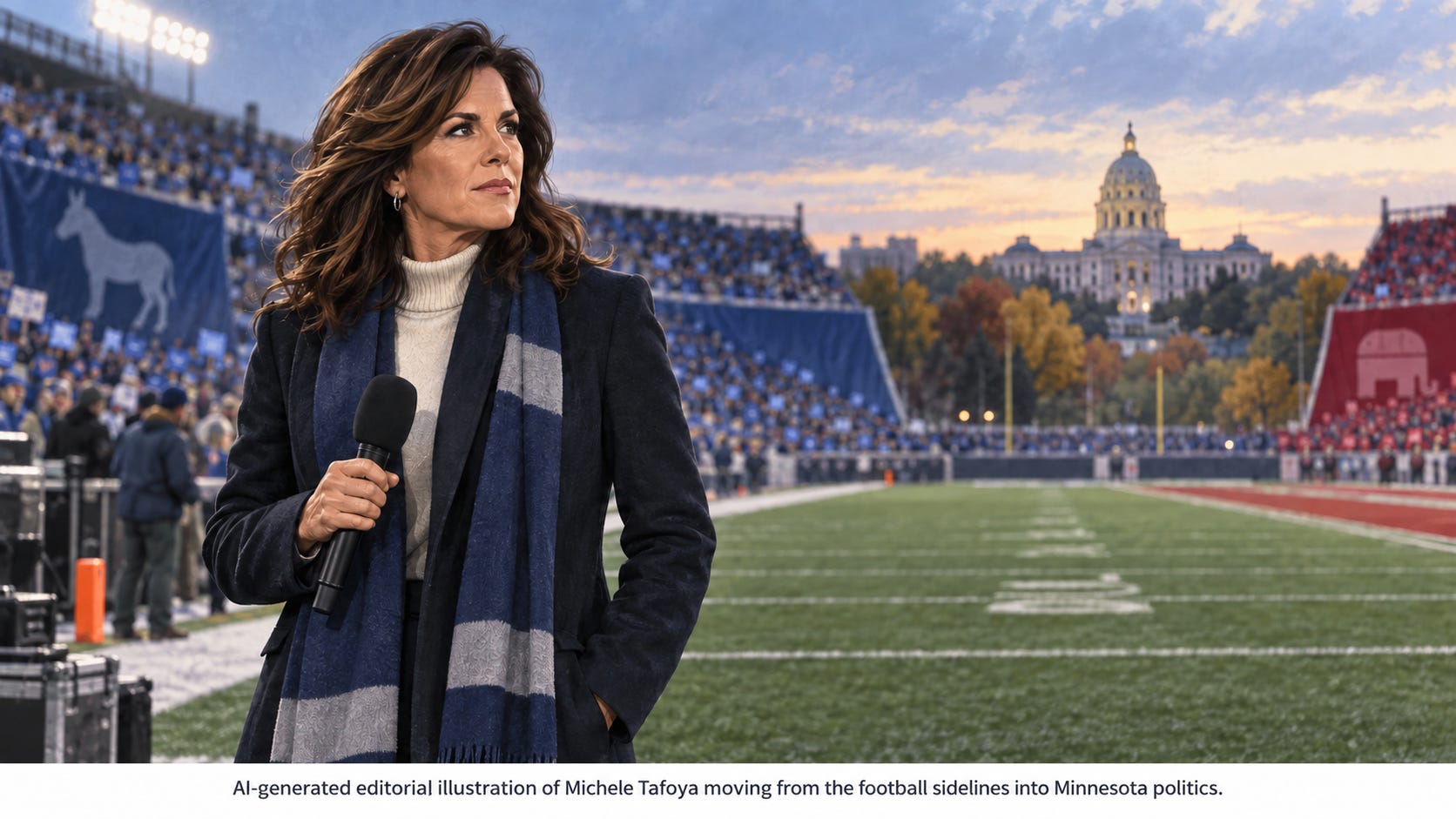
Texas has received considerably more national attention than Minnesota because Ken Paxton’s nomination has given Democrats an unusual opportunity in a traditionally Republican state. Minnesota deserves greater scrutiny because it appears to be a more competitive political environment than Texas.
· Kamala Harris carried Minnesota by only 4.2 percentage points in 2024, while Donald Trump carried Texas by 13.7 points.
Minnesota remains a blue state and Texas a red one, but the most recent presidential results place Minnesota considerably closer to the partisan midpoint.
Minnesota’s open Senate race is shaped by three powerful headwinds.
· Peggy Flanagan must persuade centrists that her agenda is meaningfully different from the socialist one.
· Peggy Flanagan must explain or at least discuss the extensive fraud in state-administered social-service programs during the Walz–Flanagan administration.
· Michele Tafoya must persuade voters that electing her would not simply provide another vote for Trump.
Peggy Flanagan
Flanagan has served as Minnesota’s lieutenant governor since 2019. A citizen of the White Earth Nation, she previously served on the Minneapolis Board of Education and in the Minnesota House of Representatives. If elected, she would become the first Native American woman to serve in the United States Senate.
Flanagan enters the general election after defeating U.S. Representative Angie Craig 59.0% to 39.4% in the DFL primary. Craig offered a more centrist argument based on her record of winning a competitive House district. Their principal differences included:
· Health care: Flanagan supports Medicare for All; Craig favored a public option.
· Immigration: Flanagan attacked Craig’s vote for the Laken Riley Act and called for tearing ICE apart and rebuilding it.
· Israel and campaign support: Flanagan criticized Craig’s support from groups associated with AIPAC, has claimed that Israel is committing genocide in Gaza, and took a more restrictive position on military assistance to Israel.
· Governing record: Craig blamed the Walz–Flanagan administration for failing to prevent extensive fraud in state social-service programs.
Flanagan’s decisive victory confirmed the strength of Minnesota’s progressive DFL coalition. Although she rejects the democratic-socialist label and stops short of some of the DSA’s most radical proposals, she embraces much of its immediately actionable agenda.
Her general-election question is whether Craig’s more moderate and suburban-oriented voters will remain with the party.
Flanagan’s record as lieutenant governor creates another vulnerability. Extensive fraud occurred in state-administered social-service programs during the Walz–Flanagan administration. Flanagan has emphasized that Governor Walz took the lead in responding, while Craig accused her of refusing to accept responsibility. Minnesota lieutenant governors have few independent statutory duties, and there is no evidence that Flanagan personally administered the affected programs. But she was publicly presented as Walz’s governing partner for most of their time in office, making it difficult for her to claim the administration’s accomplishments while separating herself completely from its failures.
That question is complicated by a documented rift between Flanagan and Walz. The two rarely appeared together during the past year and a half, and Walz declined to endorse her in the DFL primary.
Michele Tafoya
Tafoya is a first-time candidate but a familiar public figure. She spent decades as a sports broadcaster, most prominently as an NFL sideline reporter for NBC. After leaving full-time sports broadcasting, she became a conservative commentator.
Tafoya won the Republican primary with 52.1%, defeating convention-endorsed former Navy SEAL Adam Schwarze, who received 24.0%, and 2024 Senate nominee Royce White, who received 11.2%.
Her majority demonstrated the value of statewide name recognition and showed that her abortion-rights position and acceptance of the 2020 election were not disqualifying among Republican primary voters. It did not, however, establish how much distance she is prepared to put between herself and Trump in the general election.
Tafoya entered the campaign as the Republican with the greatest statewide name recognition. She has emphasized government fraud, public safety, immigration enforcement, manufacturing and political accountability. Her principal Minnesota-focused argument is that the DFL administration failed to prevent large-scale fraud in publicly funded programs. Because Flanagan has served as lieutenant governor throughout the Walz administration, Tafoya argues that she shares responsibility for those failures.
Tafoya differs from much of the national Republican Party on some questions. She describes herself as pro-choice and has said there is room in the Republican Party for supporters of abortion rights. She accepts the result of the 2020 presidential election and distinguishes between illegal immigration and legal immigration. She has also said that she is running her own campaign rather than serving as an extension of Trump.
Those differences coexist with significant areas of alignment. Tafoya said she would welcome Trump’s endorsement. She has defended his economic record, supported his military policy toward Iran and generally aligned herself with Republican arguments on immigration enforcement. When asked whether Trump should be permitted to impose tariffs unilaterally, she declined to take a position.
Tafoya’s challenge is therefore not simply to establish that she is personally different from Trump. Voters will also want to know how she would vote when his policies conflict with Minnesota’s agricultural, manufacturing or institutional interests—and whether she can offer practical alternatives on health care, climate change and Middle East peace, where neither the Trump agenda nor the democratic-socialist agenda is likely to produce sufficient progress.
Flanagan gives Tafoya openings, particularly on health care and Israel. Medicare for All is neither politically feasible nor adequately attentive to the cost and disruption of replacing employer-sponsored insurance. Yet simply defending the Republican record is not enough: the health-care system remains unaffordable for many families, and the expiration of the enhanced ACA subsidies has made matters worse. Tafoya needs an alternative that expands coverage while controlling costs. I have proposed one in “A Durable Path Forward on American Health Care.”
Flanagan’s description of the Gaza war as genocide and her support for restricting weapons to Israel may also place her outside the comfort zone of many Minnesota voters, particularly Jewish Democrats. Progressive denunciations that minimize Israel’s security concerns do not bring peace closer; they can encourage Palestinian leaders to believe that continued resistance will eventually deprive Israel of American support. Representative Haley Stevens recently made a similar point, questioning what Senator Bernie Sanders’s increasingly strident rhetoric had accomplished for Middle East peace. (Fox News report)
Tafoya should also ask whether Flanagan’s spending commitments are sustainable as Social Security and Medicare approach trust-fund depletion and automatic reductions in scheduled benefits. The argument that Congress needs pragmatic problem-solvers—not one more ideological senator—as it confronts these looming cuts is compelling.
Trump’s tariffs provide another test of Tafoya’s independence. They are especially consequential in Minnesota because Canada is the state’s largest trading partner, purchasing roughly $5.5 billion in Minnesota exports annually. Some Republicans have broken with Trump on this issue: Colorado Representative Jeff Hurd was one of six House Republicans who voted to terminate Trump’s tariffs on Canada.
Tafoya’s support for legal immigration establishes part of her position, but it does not answer the separate controversy surrounding the Trump administration’s ICE tactics. Opposition to those actions gives Democrats a powerful tailwind. Demonstrating that she is more reasonable than Flanagan may therefore not be enough; voters will also want to know where Tafoya’s own limits lie.
At the same time, Tafoya can identify Trump policies she supports and propose building upon them. She could favor expanding federal contributions to Trump Accounts so that more children begin adulthood with meaningful savings, while extending the tax relief for tips beyond its scheduled expiration. That would allow her to demonstrate independence without defining independence as opposition to Trump on every issue.
Minnesota could therefore become an overlooked competitive race. Flanagan’s progressive positions and the fraud controversies surrounding the Walz administration create genuine vulnerabilities.
Politics should be about more than creating contrasts. It should include a serious discussion of how the country moves forward. Tafoya can make this a race if she shows not only where she differs from Trump, but also what she would do differently—and how her alternatives would produce more progress than either Trump’s program or Flanagan’s.
I would also like to see Tafoya go further by advocating fiscally responsible improvements to health care and student debt along the lines I have outlined in my own work. With fewer than 60 days before the election, complex proposals may appear politically inconvenient. But asking when it is convenient to introduce a difficult policy is rather like asking when it is convenient to have a baby. If the problem is real and the work is necessary, perpetual postponement is not a solution.
Sources
· Minnesota Secretary of State: August 11, 2026 U.S. Senate primary results
· Minnesota Public Radio comparison of Flanagan and Craig
· Minnesota Star Tribune comparison of Flanagan and the DSA
· NOTUS interview with Michele Tafoya
· Minnesota Public Radio report on the Craig–Flanagan debate and fraud
· Minnesota Star Tribune report on the Flanagan–Walz rift
· Jewish Insider report on Flanagan, Craig, AIPAC and Democratic divisions over Israel
· Minnesota Public Radio profile of the Flanagan–Tafoya general-election matchup
Crucial Races
Author’s Note: I am working on a series the Race of the Day, which appears most days with some gaps for when I must finish a consulting or policy task. Go here for a discussion of the race in NY-17 between Conley and Lawler. For readers interested in my broader policy agenda, see If I Were Speaker: A Tax Reconciliation Agenda, which lays out proposals on health care, student debt, capital gains taxation and retirement policy. Also, this post on the fiscal cliff, which will next be reached right before a funding crisis impacting Social Security is a must read for any future Senator or staff member.
I’m also offering new paid subscribers for only a short while a 50% off their first-year coupon. Paid subscriptions support this work and provide access to my more detailed policy and economic analysis.
Since writing this post a month ago the polls in Minnesota have tightened and the state could buck the trend by flipping D to R. Democrats are doing better in blue states than red ones, hence it is possible that things will tighten in red states but a loss could occur in one or more blue states. https://medium.com/the-political-prism/will-republicans-flip-minnesota-f57f7b5b2f0d?sharedUserId=bernstein-book1958
Democrats are treating independents Dan Osborn in Nebraska and Seth Bodnar in Montana as plausible routes to Senate seats in states Donald Trump carried overwhelmingly. Osborn has attracted enough national attention to be profiled as “the Independent Senate Candidate Who Could Tip Nebraska”.
Yet Minnesota—an open seat with a progressive Democratic nominee carrying vulnerabilities from the Walz administration—barely appears on many lists of races worth watching. Minnesota still leans Democratic, but is the conventional wisdom overlooking the more plausible upset?