

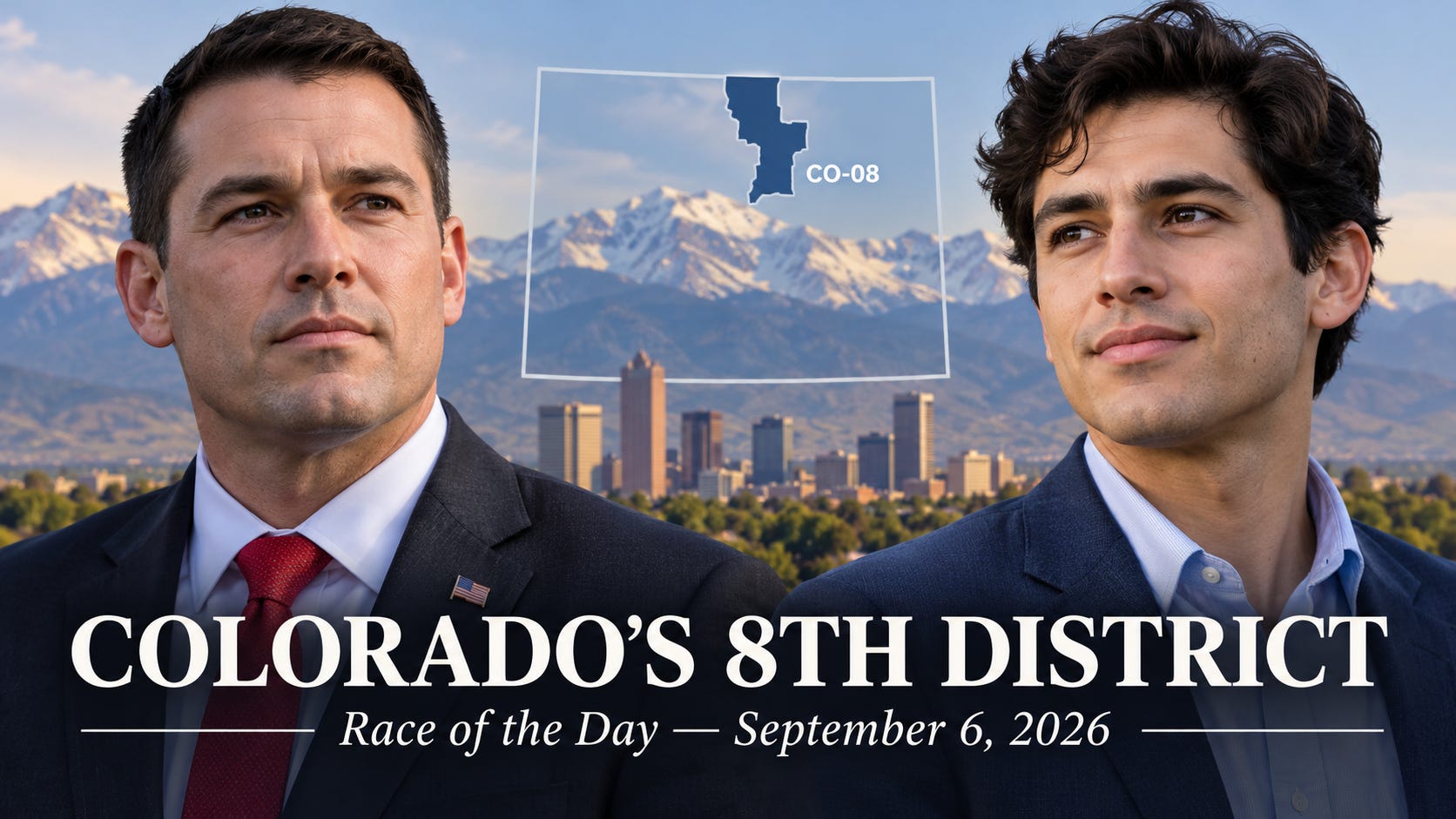
I skipped yesterday’s Race of the Day to finish a finance article. Today I return closer to home: Colorado’s 8th Congressional District, just north of Denver, where I live.
Colorado’s 8th is the state’s newest congressional district, created after Colorado gained an additional House seat following the 2020 census. It runs from the northern Denver suburbs through Adams and Weld counties toward Greeley, combining a large Latino population and Democratic-leaning suburbs with more Republican agricultural communities farther north. Hispanics or Latinos made up 38.5% of the district’s population when the current lines were drawn.
And competitive hardly begins to describe it.
This is only the district’s third congressional election.
In 2022, Democrat Yadira Caraveo, a physician and former state legislator, became its first representative, defeating Republican Barbara Kirkmeyer 48.4% to 47.7%.
Two years later, Republican Gabe Evans defeated Caraveo 49.0% to 48.2%. In both elections, the winner received less than 50% and prevailed by less than one percentage point.
Once again, CO-08 is among the country’s most closely watched House races, featuring two very different candidates.
Gabe Evans, the Republican incumbent
Evans, 40, has a résumé rooted in the military, law enforcement and emergency response.
He spent 12 years in the Army and Colorado Army National Guard, flew Black Hawk helicopters, served during Operation Enduring Freedom, and commanded aviation units involved in Colorado wildfire response and search-and-rescue missions. He then spent more than a decade with the Arvada Police Department, rising to lieutenant. Evans and his wife also operate a family farm in Weld County.
Politically, Evans has supported President Trump on many major issues and was endorsed by Trump in both 2024 and 2026. Evans, however, rejects the characterization that he follows the administration in lockstep. He points to bipartisan legislation and his membership in the Problem Solvers Caucus, while identifying several areas where he has disagreed with Trump administration policy.
Manny Rutinel, the Democratic challenger
Manny Rutinel, 31, could hardly have followed a more different path.
Raised by a single immigrant mother, he worked at McDonald’s, studied economics and microbiology, earned a master’s in applied economics from Johns Hopkins and a Yale law degree, and worked as an economist for the Army Corps of Engineers before entering the Colorado legislature.
Rutinel also has a long record of political and issue activism.
As a University of Florida student in 2014, he participated in a demonstration connecting police brutality in Ferguson with the treatment of Palestinians in Gaza. The demonstration included Students for Justice in Palestine among its organizers. Rutinel’s campaign has said he was never affiliated with SJP and attended the demonstration to protest police brutality in the United States.
At Yale in 2019, Rutinel joined protesters who entered the field during the Harvard-Yale football game to demand that the universities divest from fossil fuels. He was charged with disorderly conduct; the charge was later dropped. His work at Yale also concentrated heavily on animal and environmental law, including proposals to use carbon-offset credits to encourage farmers to transition from animal agriculture toward plant production.
Those positions are potentially significant in a district containing major oil-and-gas production as well as substantial agricultural interests. Weld County has historically accounted for the overwhelming majority of Colorado crude-oil production.
Rutinel has since changed several positions. As recently as July 2025, he supported banning fracking, canceling student debt and creating a single-payer health-care system. During this campaign, he has opposed a fracking ban, rejected blanket student-debt cancellation and favored exploring a public option rather than Medicare for All.
Karl Rove highlighted this vulnerability in his July Wall Street Journal column, “Socialists Spell Trouble for Democrats,”arguing that progressive primary victories may be relatively painless in deep-blue districts but create different political challenges elsewhere. Rutinel was among the Colorado candidates Rove discussed.
Rutinel did not simply inherit the nomination. Democratic primary voters had a sharply different alternative.
Former state Rep. Shannon Bird presented herself as the pragmatic candidate with a record of bipartisan legislating. She had served seven years in the Colorado House and chaired the powerful Joint Budget Committee. The independent Center for Effective Lawmaking ranked Bird the most effective Colorado state legislator in the 2023–24 legislative session.
Yet Democratic voters chose Rutinel overwhelmingly: roughly 61–62% to Bird’s 34%, with military veteran Evan Munsing receiving about 5%. Rutinel ran as the more progressive candidate, while Bird emphasized a more moderate political profile and argued that it would appeal to unaffiliated and swing voters.
That result occurred alongside other progressive victories in Colorado’s June primaries, most notably Melat Kiros’s defeat of longtime Denver Rep. Diana DeGette. Republicans have since openly attempted to tie Rutinel and other Colorado Democrats to Kiros.
Libertarian Dave Wood is also running. In a district whose first two elections were decided by only a few thousand votes, third-party voting bears watching. In 2022, the Libertarian candidate received more than 9,200 votes while Caraveo’s margin over Kirkmeyer was about 1,600 votes; in 2024, two minor-party candidates together received more than 9,000 votes while Evans’s margin over Caraveo was about 2,500.
Colorado 8 provides a striking contrast with my September 4 Race of the Day, Washington’s 3rd District.
Both are closely divided districts, but Washington 3 produced two candidates with relatively moderate political profiles. Colorado 8 produced a Republican who has supported Trump on many of the administration’s major priorities and a Democrat whose earlier positions on several issues were substantially to the left of those he now emphasizes.
That raises a larger question with broader 2026 implications:
Why do some closely divided districts nominate candidates oriented toward the political center, while others produce much sharper ideological choices?
President Trump’s current standing gives Democrats an issue they are trying to exploit nationally and in Colorado 8. Recent polling also shows substantial dissatisfaction with Trump among Latino voters in the district. At the same time, Rutinel’s decisive primary victory over a more moderate Democratic alternative makes Colorado 8 an unusually useful test of whether a candidate with a distinctly progressive political history can assemble a winning coalition in one of the country’s most evenly divided districts.
Author’s Note: For readers interested in my broader policy agenda, see If I Were Speaker: A Tax Reconciliation Agenda, which lays out proposals on health care, student debt, capital gains taxation and retirement policy.
Crucial Races
I’m also offering new paid subscribers for only a short while a 50% off their first-year coupon. Paid subscriptions support this work and provide access to my more detailed policy and economic analysis.
One perhaps not entirely serious explanation for Manny Rutinel’s landslide primary victory comes from the late Gloria Steinem.
In 2016, trying to explain why young women were supporting Bernie Sanders rather than Hillary Clinton, Steinem famously said: “Where are the boys? The boys are with Bernie.” She later apologized for the remark. Here’s the contemporary account.
Rutinel is, after all, a young and photogenic candidate. And he defeated Shannon Bird—a highly accomplished woman with seven years in the Colorado legislature and a record of legislative effectiveness—by an enormous margin, roughly 63% to 33%.
That explanation seems a little hard to square with all the talk about America’s “dating recession.” But then again, who knows?