

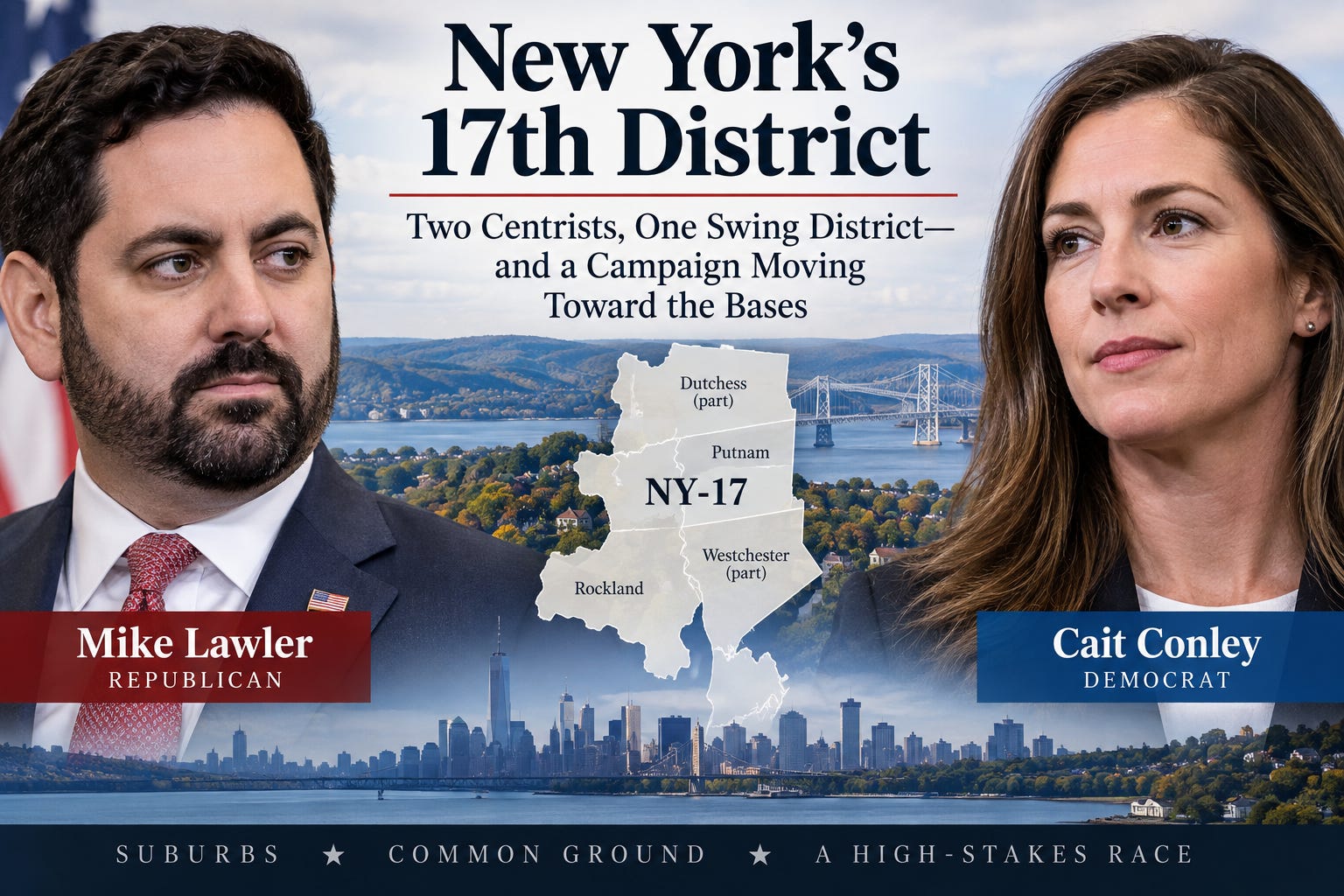
New York’s 17th District should be almost tailor-made for centrist politics. Instead, Republican Mike Lawler and Democrat Cait Conley—two candidates with substantial résumés and relatively moderate profiles—are increasingly fighting a nationalized campaign centered on Donald Trump, Democratic socialists and Defense Secretary Pete Hegseth.
The district sits immediately north of New York City and includes all of Rockland and Putnam counties and parts of Westchester and Dutchess counties. It is affluent, highly suburban and politically competitive. The district also contains a significant Jewish population, including large Orthodox and Hasidic communities in Rockland County.
Its recent electoral history illustrates just how competitive it is. Lawler first won the seat in 2022 by defeating Democratic Congressional Campaign Committee chairman Sean Patrick Maloney, 50.3–49.7. In 2024, Kamala Harris narrowly carried the district, roughly 50–49, while Lawler simultaneously defeated former Democratic congressman Mondaire Jones 52.2–45.9. Lawler is one of only three House Republicans representing districts Harris carried in 2024.
Two unusually substantial candidates
Lawler is a lifelong Hudson Valley resident and Manhattan College graduate with degrees in accounting and finance. Before Congress, he served in the New York State Assembly, as deputy town supervisor in Orangetown and as executive director of the New York Republican Party. In Congress, he serves on the House Financial Services and Foreign Affairs committees.
His legislative record deserves more attention than the campaign’s daily partisan combat sometimes suggests. Lawler has worked on housing, financial regulation and other bread-and-butter issues. Six bipartisan housing bills he authored were incorporated into the 21st Century ROAD to Housing Act, which passed Congress overwhelmingly and became law this summer. The measures address subjects including middle-class housing, public-housing accountability, housing accessibility and community development. He has also worked across the aisle on financial and retirement issues.
In other words, whatever one thinks of Lawler politically, lack of substance is not really the issue.
Conley has an equally striking, although very different, résumé. A fourth-generation Hudson Valley native, she graduated from West Point in the top 2 percent of her class, spent 16 years on active duty in the Army and deployed overseas six times, including service in Iraq and Afghanistan. She later attended graduate programs at Harvard and MIT and served in counterterrorism roles on the National Security Council and at the Cybersecurity and Infrastructure Security Agency.
Conley also had to win a competitive Democratic primary. Five Democrats made the June ballot. She won 48.9 percent of the vote, comfortably defeating Rockland County legislator Beth Davidson, who received 31.4 percent, and Effie Phillips-Staley, who finished third with 15.1 percent. Lawler was unopposed for the Republican nomination.
If both are centrists, why doesn’t the campaign sound centrist?
That may be the most interesting question in this race.
Conley appeared on CNN Sunday and said she would support articles of impeachment against Hegseth, calling him a hazard to American national security. Given her military and national-security background, her criticism of Hegseth is hardly surprising, and I understand the sentiment. But poor performance—even in a position as crucial as secretary of defense—is not by itself sufficient grounds for impeachment. The Constitution establishes the standard as “Treason, Bribery, or other high Crimes and Misdemeanors.”
House Democrats who have already introduced impeachment articles against Hegseth allege specific misconduct, not simply incompetence. But based on the case Conley made Sunday, I remain unconvinced that removal through impeachment follows simply from the argument that Hegseth has performed badly or endangered national security through poor judgment. Turning criticism of Hegseth into an impeachment argument inevitably moves the discussion into much more partisan territory.
Republicans, meanwhile, are trying to tie Conley to New York’s increasingly influential socialist left. Conley has said she will not campaign with figures such as Mayor Zohran Mamdani or Alexandria Ocasio-Cortez, but she has stopped short of a broader repudiation of the Democratic Socialists of America. That distinction could matter in suburban New York, where the recent success of Mamdani and other candidates associated with the socialist left gives Republicans an obvious line of attack.
Lawler has the mirror-image problem. He has repeatedly presented himself as an independent-minded Republican and can point to a bipartisan legislative record and occasions when he has challenged Trump, including during negotiations over the SALT deduction. Yet Lawler is scheduled to speak at this week’s Republican midterm convention in Dallas alongside a heavily Trump-oriented lineup. Trump himself is scheduled to address the convention, whose organizers have made mobilizing Trump voters a central objective.
So what do we have here? Lawler, a candidate who can’t or won’t break ties with Trump, and Conley, a candidate who can’t or won’t fully separate herself from the socialist left.
NY-17 is a curious contest: two candidates whose biographies and records suggest moderation and substantive governing experience, but whose campaigns are increasingly being pulled toward national partisan conflict. The two candidates in WA-3 appear to have done a better job asserting their independence from their parties than the two candidates in NY-17.
Author’s Note: For readers interested in my broader policy agenda, see If I Were Speaker: A Tax Reconciliation Agenda, which lays out proposals on health care, student debt, capital gains taxation and retirement policy.
I’m also offering new paid subscribers for only a short while a 50% off their first-year coupon. Paid subscriptions support this work and provide access to my more detailed policy and economic analysis.
Crucial Races
The admonition by the Democratic AG for Jews in the Democratic Party to vote for the good of mankind not their own security, a really big ask, one that this Jewish Democrat can't follow. https://jewishinsider.com/2026/09/ally-chemtob-mike-lawler-endorsement-antisemitism-israel-record/. the alarming issue from a Democrats perspective in this case is that Conley, the opponent of Lawler is not that bad but Jews have to concerned about what will policies impacting Israel and anti-semitism or opposition to Jews who don't tow the party line on Israel if the Democrats get the majority.
what needs to happen for things to get done in Washington is for the winner of this race to start behaving like Glueskamp.